
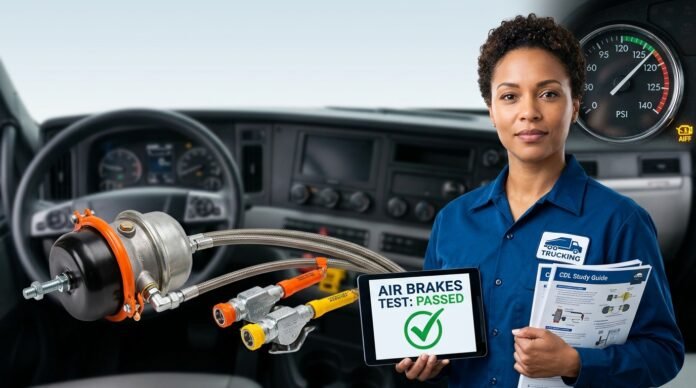
...
23 C
London
HomeCDL TrainingCDL Air Brakes & Combination Vehicles Test 2026: Questions & Guide

CDL Air Brakes & Combination Vehicles Test 2026: Questions & Guide

Last Updated: April 2026

In March 2026, a Class A driver in Ohio failed his CDL Air Brakes & Combination Vehicles Test three times before discovering he’d been studying outdated materials from 2019. The state DMV flagged his fourth attempt for manual review, delaying his commercial driving career by six weeks and costing him a pre-arranged job offer worth $68,000 annually. Air brake systems account for 34% of all roadside inspection violations according to FMCSA’s 2025 enforcement data, making this knowledge critical not just for passing tests but for avoiding CSA points that follow you throughout your entire driving career.

The CDL air brakes & combination vehicles test represents one of the most technically demanding written examinations in commercial driver licensing. Unlike passenger vehicle braking systems, air brakes operate on principles of pneumatic pressure, lag time, and multi-system redundancy that require precise understanding. When you add the physics of combination vehicles—articulation points, offtracking, trailer swing, and coupling mechanics—you’re dealing with knowledge that directly impacts highway safety and your earning potential.

This guide delivers the complete roadmap to conquering both examinations in 2026, with current FMCSA standards, state-specific variations, real test questions, and the technical foundation you need to operate Class A vehicles safely.

Key Takeaways

1

The air brakes endorsement removal and combination vehicles test are separate examinations required for Class A CDL operation in all 50 states.

2

You must score 80% or higher (typically 20 out of 25 questions correct) on each test to pass.

3

Air brake system knowledge covers seven major components: compressor, governor, air storage tanks, brake chambers, foundation brakes, brake pedal, and supply/service lines.

4

Combination vehicle physics includes trailer offtracking (up to 8 feet in tight turns), rearward amplification during emergency stops, and jackknife prevention techniques.

5

Failing either test does NOT invalidate your general knowledge exam—you can retake individual sections based on state retesting policies.

6

Entry-Level Driver Training (ELDT) mandates as of 2022 require theory instruction on both topics before taking these tests.

What Is the CDL Air Brakes & Combination Vehicles Test?

The CDL air brakes test is a written knowledge examination that removes the “L” restriction from your commercial driver’s license. Without passing this test, your CDL will contain a restriction code prohibiting you from operating any vehicle equipped with air brakes—effectively barring you from most Class A tractor-trailers, many Class B straight trucks, and specialized equipment.

The combination vehicles test evaluates your understanding of coupling/uncoupling procedures, multi-unit vehicle dynamics, and the unique handling characteristics of articulated vehicles. This test is mandatory for Class A CDL applicants who intend to operate vehicle combinations with a Gross Combination Weight Rating (GCWR) exceeding 26,001 pounds where the towed unit exceeds 10,000 pounds.

Both examinations are computer-based in 47 states as of April 2026, with Montana, Wyoming, and Vermont still offering paper alternatives. Testing occurs at state DMV facilities or authorized third-party testing centers. According to data from the Commercial Driver’s License Information System (CDLIS), the national first-attempt pass rate for air brakes sits at 73%, while combination vehicles shows an 81% pass rate.

CDL air brakes test computer screen showing sample questions at DMV testing center with touchscreen interface and timer display

Why These Tests Matter Beyond Licensing

The technical knowledge tested isn’t academic. Air brake failure contributed to 29% of all truck-involved crashes analyzed in the FMCSA’s 2024 Large Truck Crash Causation Study update. Understanding lag time—the 0.5 to 0.8 seconds between brake application and actual braking force—determines whether you stop safely or impact the vehicle ahead during highway emergencies.

Combination vehicle dynamics affect daily operations. A driver who doesn’t understand offtracking will clip curbs during right turns, damaging tires worth $400 each and potentially causing third-party property damage. Improper trailer coupling causes separation incidents that result in automatic preventable crash designations on your PSP report, affecting your insurability and employment prospects for three years.

Insurance carriers review these test scores during underwriting. Companies like Progressive Commercial and Northland Insurance request full DMV records showing first-attempt passes versus multiple retakes. Some fleet operators implement internal policies requiring drivers to demonstrate 90% or higher scores on both tests as a hiring prerequisite, even though state law only requires 80%.

Air Brake System Components You Must Know

The Compressor and Governor System

The air compressor is belt-driven or gear-driven from the engine, producing compressed air at approximately 125 PSI. Most modern systems use reciprocating piston compressors with cooling fins and oil lubrication connected to the engine’s oil supply.

The governor controls compressor operation through cut-in and cut-out pressures. Standard settings place cut-out at 125 PSI (when the governor stops the compressor from pumping) and cut-in at 100 PSI (when pumping resumes). Test questions frequently ask about these specific numbers and what happens if the governor fails.

A malfunctioning governor that doesn’t cut out will cause pressure to build beyond safe limits, potentially rupturing air lines or damaging the brake system. Conversely, a governor stuck in cut-out mode leaves the compressor inactive, causing gradual pressure loss that will eventually trigger the low air pressure warning at 60 PSI.

Air Storage Tanks and the Wet Tank Principle

Modern air brake systems use multiple tanks with specific purposes. The supply tank (wet tank) receives air directly from the compressor and contains an automatic moisture ejector or manual drain valve. Water condensation is inevitable as compressed air cools—failing to drain wet tanks daily can introduce moisture into brake valves, causing freeze-ups in winter conditions.

Primary and secondary tanks feed the service brake system. Federal regulations require tank capacity sufficient to allow full brake applications after the engine stops and air pressure depletes. Test scenarios often describe pressure loss situations and ask how many brake applications remain before the spring brakes activate.

The one-way check valve between tanks prevents total pressure loss if one tank ruptures. You might see test questions describing a primary tank leak and asking which brakes remain functional—the answer depends on tank configuration, typically leaving you with either front or rear axle braking capability.

Foundation Brakes: S-Cam vs. Wedge Systems

The S-cam brake design dominates heavy-duty applications. When you press the brake pedal, air pressure pushes against the diaphragm in the brake chamber, extending the pushrod. This rod connects to a slack adjuster (the adjustment mechanism for brake shoe clearance) which rotates the S-cam shaft. The S-shaped cam forces brake shoes outward against the drum, creating friction.

Wedge brakes use a wedge mechanism that slides between the brake shoes, forcing them apart. These systems offer faster application but are less common in modern heavy vehicles. Test questions may show diagrams of both systems and ask you to identify components.

Automatic slack adjusters became mandatory on vehicles manufactured after 1994, but manual adjustment knowledge still appears on tests. You need to know the proper arm angle (90 to 100 degrees when brakes are released) and the maximum allowable pushrod travel (typically 1¾ to 2¼ inches depending on chamber size).

Supply and Service Air Lines

Supply lines (emergency line, typically red) provide air to charge the trailer air tanks and control the emergency relay valve. When you disconnect this line or pressure drops below 20-45 PSI, spring brakes on the trailer automatically apply.

Service lines (blue) carry controlled air pressure from the tractor’s foot valve to the trailer’s service brakes, providing graduated braking force proportional to pedal application.

A critical test concept: if the service line ruptures, you lose trailer service brakes but retain emergency/parking brake function. If the supply line fails, trailer spring brakes lock immediately. Understanding this difference helps you answer scenario questions about what happens during specific line failures.

Complete Air Brake System Testing Procedures

The Seven-Step Air Brake Check

According to ELDT requirements, you must demonstrate knowledge of this systematic inspection during your CDL pre-trip inspection. These same steps appear repeatedly on written tests.

Step 1: Check Air Compressor Governor Cut-In and Cut-Out
With engine running, rapidly pump the brake pedal to reduce air pressure. Note when the governor cuts in (around 100 PSI) and cuts out (around 125 PSI). The compressor should build from 85 to 100 PSI within 45 seconds at 600-900 RPM.

Step 2: Test Low Air Pressure Warning
Continue pumping brakes with the key on but engine off. The low air warning light and buzzer must activate before pressure drops below 60 PSI. Some test questions specify 55 PSI as the maximum allowable threshold.

Step 3: Check Rate of Air Pressure Buildup
From approximately 85 PSI, time how long the system takes to build to 100 PSI. Single-vehicle systems should accomplish this in 45 seconds. Combination vehicles may take up to 2 minutes depending on system volume.

Step 4: Test Air Leakage Rate (Static Test)
Build system to maximum pressure, then turn off the engine and release the parking brake. Air loss should not exceed 2 PSI per minute for single vehicles or 3 PSI per minute for combinations. Excessive leakage indicates system deterioration requiring repair before operation.

Step 5: Check Spring Brake (Parking Brake) Operation
With full system pressure, shut down the engine and repeatedly apply service brakes. The parking brake valve should pop out (applying spring brakes) when pressure drops to the range of 20-40 PSI. This emergency backup system prevents runaway vehicles if air pressure fails completely.

Step 6: Service Brake Functionality Test
At approximately 90 PSI with the engine off, apply firm brake pedal pressure and hold for one minute. The pedal should not sink, indicating no internal valve leakage. Pedal fade suggests air escaping past seals in the brake valve or chambers.

Step 7: Parking Brake Hold Test
Apply parking brakes and attempt to move the vehicle in low gear. The vehicle should not move. This confirms spring brake holding power and proper adjustment.

FMCSA Warning: Operating a commercial vehicle with an air brake system that fails any of these seven tests constitutes an out-of-service violation under 49 CFR § 396.9. Enforcement personnel can place your vehicle out of service immediately, and violations appear on your inspection report for 24 months.
Air brake system diagram showing compressor governor air tanks brake chambers supply and service lines with pressure gauges and component labels

Combination Vehicle Coupling and Uncoupling

The Five-Step Coupling Sequence

Proper coupling prevents trailer separation incidents that killed 19 people in the U.S. during 2024 according to NHTSA crash data. Test questions describe scenarios with missing steps and ask what hazard results.

Step 1: Inspect Fifth Wheel and Kingpin
The fifth wheel plate must show no cracks, secure mounting (all bolts tight), and adequate grease on the surface. The kingpin on the trailer should be straight (not bent), free of damage, and the proper diameter (2 inches for standard applications, 3.5 inches for heavy-haul).

Platform height matters. The trailer nose should sit slightly below the fifth wheel—if too high, you risk riding over the kingpin; too low creates excessive gap requiring the tractor to “climb” during coupling.

Step 2: Position Tractor and Back Under Trailer
Align the tractor centerline with the kingpin. Back slowly until you feel the initial contact between the fifth wheel and trailer. The approach angle should be straight—angling more than 5 degrees can cause the kingpin to strike the side of the fifth wheel throat rather than entering properly.

Step 3: Lock the Fifth Wheel
Continue backing until you hear the jaws close around the kingpin. Modern fifth wheels produce an audible “clunk” when locked. Never assume coupling is complete without verification.

Step 4: Visual and Physical Verification
Exit the cab and visually inspect the locking mechanism. You should see no gap between the upper coupler (apron) and the fifth wheel, and the release handle must be in the locked position (typically down or forward depending on manufacturer). Physically test by attempting to pull forward gently in low gear with the trailer brakes set—the kingpin should not release.

Step 5: Connect Air Lines and Electrical
Attach the red (supply) glad hand first, then blue (service) glad hand. Cross-connecting these lines causes trailer brakes to remain released when you intend to apply them—a dangerous reversal. Connect the electrical line for lights and ABS.

Raise the landing gear fully to prevent damage during turns. Test questions often ask about proper landing gear positioning: fully raised for travel, lowered to just clear the ground for uncoupled trailers.

Uncoupling Procedure and Safety Checks

Before uncoupling, verify the trailer is on firm, level ground. Coupling on soft surfaces has caused trailers to sink after uncoupling, making recoupling impossible without recovery equipment.

Lower the landing gear until both shoes contact ground firmly, then crank an additional 4-6 turns to transfer weight. Release the fifth wheel lock only after landing gear supports full trailer weight. Attempting to unlock while the trailer is still supported by the tractor can jam the mechanism.

Pull forward slowly while observing the trailer in mirrors. If the trailer moves with you, the kingpin hasn’t released—stop immediately and reset the coupling. Complete separation while the trailer is still resting on its landing gear constitutes a kingpin release failure and potential coupling damage.

Combination Vehicle Handling Characteristics

Offtracking and Swept Path Calculations

Offtracking describes how trailer wheels follow a tighter path than the tractor during turns. The longer the wheelbase and the sharper the turn, the greater the offtracking distance. A 53-foot trailer making a 90-degree turn at low speed can offtrack up to 8 feet from the tractor’s path.

This physics explains why you must swing wide during right turns. Test questions show intersection diagrams and ask how much space to allow. The correct answer accounts for the trailer cutting the corner—inadequate space results in the trailer wheels climbing curbs or striking fixed objects.

Left turns require different techniques. You should position the tractor farther from the center line than a car would, allowing the trailer adequate clearance through the turn without entering opposing traffic lanes. Questions test whether you know to delay turn initiation until the tractor passes through the intersection.

Rearward Amplification and Offtracking During Backing

When reversing, trailer wheels amplify steering inputs. A small steering wheel turn creates exaggerated trailer movement. This rearward amplification means you must make small, gradual steering corrections when backing.

The test asks about proper backing technique: turn the steering wheel toward the mirror where you want the trailer to go. If the trailer goes the wrong direction in your mirror, turn the wheel toward that mirror to correct it. This counter-intuitive concept confuses many drivers used to forward-driving logic.

Longer combination vehicles like double or triple trailers exhibit even more pronounced rearward amplification. The second trailer in a double combination may swing 30% more than the first trailer during backing maneuvers—making precision backing nearly impossible in tight spaces.

Jackknife Physics and Prevention

tractor jackknife occurs when the tractor drive axles lock during braking (or lose traction during acceleration) while the trailer continues forward, pushing the tractor around the kingpin. This creates a V-shape as the tractor and trailer fold together.

Trailer jackknives happen when trailer wheels lock while the tractor has traction. The tractor continues forward while the locked trailer attempts to pass the tractor, again creating the characteristic V-shape.

Modern air brake systems include antilock braking systems (ABS) on vehicles manufactured after March 1998 (trailers) and March 1997 (trucks/tractors). ABS prevents wheel lockup during hard braking, significantly reducing jackknife risk. You’ll see test questions asking what the yellow ABS warning light indicates (malfunction) versus normal operation (no light).

Prevention techniques include:

  • Never braking hard while turning or on slippery surfaces
  • Recognizing slippery conditions early and reducing speed preemptively
  • Using controlled or stab braking if ABS isn’t available
  • Avoiding sudden steering movements during braking
  • Keeping cargo properly distributed (heavy toward the front)

Trailer Swing and Crack-the-Whip Effect

Trailer swing occurs during quick lane changes or swerving. The trailer continues in its original direction momentarily due to inertia, then overcorrects when the tires regain traction. In doubles and triples, this creates the crack-the-whip effect where each successive trailer experiences more violent lateral movement than the one ahead.

Test scenarios describe emergency swerves around obstacles and ask what happens to a double trailer combination. The correct answer notes that the rear trailer may roll over even though the tractor remains stable. This physics makes doubles and triples particularly dangerous during evasive maneuvers.

Speed management prevents trailer swing. Posted speed limits assume single-unit vehicles—combination vehicles should reduce speed by 5-10 mph on curves and ramps. Questions test whether you know recommended speed reductions for specific conditions.

Ready to Test Your Knowledge?

Take our interactive CDL Air Brakes & Combination Vehicles practice quiz. 25 questions, instant results, and detailed explanations.

✓ 25 Questions ✓ 60 Minutes ✓ Instant Results ✓ Free
Start Quiz Now

Sample Test Questions for Air Brakes

Understanding real test questions helps you recognize patterns and priority topics. These examples reflect actual AAMVA CDL test bank content used across multiple states:

Question 1: What activates the low air pressure warning signal?
Answer: Air pressure falling below 60 PSI activates both the visual warning light and audible buzzer.

Question 2: Why must you drain water from compressed air tanks?
Answer: Water condensation in air lines can freeze during cold weather, blocking air flow and causing brake failure.

Question 3: What is the purpose of the safety relief valve in the air brake system?
Answer: The safety valve automatically releases air pressure if the system exceeds approximately 150 PSI, preventing tank or line rupture if the governor fails.

Question 4: How should you check that spring brakes come on automatically?
Answer: Build air pressure to normal, shut off the engine, and pump the brake pedal to reduce pressure. The parking brake valve should pop out when pressure drops to 20-40 PSI range.

Question 5: What is brake lag distance?
Answer: The distance your vehicle travels during the 0.5 second delay between pressing the brake pedal and air reaching the brake chambers. At 55 mph, this equals approximately 32 feet.

Question 6: If the low air pressure warning comes on while driving, what should you do?
Answer: Safely stop immediately and determine the cause. Continuing to drive with low air pressure risks complete brake failure when pressure depletes further.

Question 7: What controls air pressure in the air brake system?
Answer: The air compressor governor controls when the compressor pumps (cut-in around 100 PSI) and stops pumping (cut-out around 125 PSI).

Question 8: What happens if the air compressor develops a leak?
Answer: The governor will cycle more frequently as it works to maintain system pressure. Eventually, the compressor may not build pressure fast enough, causing gradual system pressure loss.

Question 9: Why should you be in proper gear before starting down a hill?
Answer: Excessive use of service brakes on long downgrades causes brake fade and potential failure. Proper gear selection uses engine compression for primary speed control.

Question 10: What type of emergency equipment must be on all commercial vehicles?
Answer: Fire extinguisher, warning triangles (three bidirectional reflective triangles), and spare fuses (if vehicle uses fuses rather than circuit breakers).

Sample Test Questions for Combination Vehicles

Question 1: When backing a trailer, you should position your vehicle so you can back in a curved path to the driver’s side because:
Answer: You can see better when backing toward the driver’s side compared to the blind side.

Question 2: What is offtracking?
Answer: When a vehicle goes around a corner, the rear wheels follow a different path than the front wheels, tracking closer to the inside of the turn.

Question 3: When you turn suddenly while pulling doubles, which trailer is most likely to turn over?
Answer: The rear trailer is most likely to turn over due to the crack-the-whip effect amplifying forces.

Question 4: Air and electric lines from the tractor to the trailer should be:
Answer: Secured with enough slack to allow turns without pulling loose or disconnecting, but not so loose they drag on the ground.

Question 5: Before backing under a trailer, you should make sure:
Answer: The trailer height is correct (slightly lower than the fifth wheel), the area is clear behind the vehicle, and the trailer is on firm, level ground.

Question 6: When coupling, the proper position of the fifth wheel is:
Answer: Tilted down toward the end of the tractor to prevent trailer nose from hitting the tractor frame during coupling.

Question 7: You are coupling a tractor and semi-trailer. You have connected the air lines. Before backing under the trailer, you should:
Answer: Supply air to the trailer system, then pull forward gently with trailer brakes locked to test the connection.

Question 8: After coupling, one way to check that the trailer is securely coupled is to:
Answer: Put the tractor in low gear and gently pull forward against the locked trailer brakes to verify the coupling holds.

Question 9: The trailer air supply control should pop out when air pressure falls to:
Answer: The range of 20-45 PSI, automatically applying trailer spring brakes if air pressure drops critically low.

Question 10: What is a converter dolly?
Answer: A coupling device with one or two axles and a fifth wheel, used to convert a semi-trailer into a full trailer for pulling doubles or triples.

Test Component Number of Questions Passing Score Time Limit Retake Policy (Typical)
Air Brakes Endorsement 25 questions 20 correct (80%) 60 minutes 1 day waiting period after failure
Combination Vehicles 20 questions 16 correct (80%) 60 minutes 1 day waiting period after failure
General Knowledge 50 questions 40 correct (80%) 90 minutes Required for both endorsements
Fifth wheel coupling mechanism showing kingpin locked position safety latch and proper connection angle for combination vehicle trailer attachment

State-Specific Variations in 2026

While FMCSA establishes federal minimum standards, individual states implement variations affecting your testing experience:

California requires additional combination vehicle questions covering earthquake-specific hazards and mountainous terrain braking procedures. The CA DMV test includes 30 combination vehicle questions instead of the standard 20.

Texas administers separate computer-based tests for each endorsement at different testing stations. Some drivers report needing to visit multiple locations to complete all CDL endorsements on the same day.

New York implements a mandatory 24-hour waiting period between any failed test and retake attempt, regardless of which specific test you failed. This policy aims to ensure adequate study time between attempts.

Florida allows unlimited same-day retakes if you fail, but charges $10 per retake attempt. Some testing centers limit you to two attempts per day due to scheduling constraints.

Pennsylvania requires proof of ELDT completion before scheduling any knowledge test, including endorsement tests. You must present your Training Provider Registry confirmation number at check-in.

These variations emphasize the importance of checking your specific state’s CDL requirements by state before scheduling tests.

Entry-Level Driver Training (ELDT) Impact

Since February 7, 2022, federal ELDT regulations require theory and behind-the-wheel training before obtaining a Class A CDL or specific endorsements. This mandate fundamentally changed how to get a CDL license.

For air brakes and combination vehicles specifically, ELDT requires:

Air Brakes Theory Instruction Must Cover:

  • Air brake system components and nomenclature
  • Dual air brake systems
  • Inspecting air brake systems
  • Using air brakes correctly (application techniques, lag time)

Combination Vehicles Theory Instruction Must Cover:

  • Combination vehicle components
  • Coupling and uncoupling procedures
  • Inspecting combination vehicles
  • Combination vehicle air brakes
  • Antilock braking systems (ABS)
  • Handling characteristics unique to combination vehicles

Training must come from providers listed on the FMCSA Training Provider Registry (TPR). Attempting to take these tests without completing TPR-certified training results in automatic test denial—the DMV cannot administer the exam until you present proof of ELDT completion.

Employers like Swift Transportation, Schneider, and Prime Inc. operate their own TPR-certified programs. Independent CDL schools near me also provide ELDT-compliant instruction, typically bundled into comprehensive CDL training packages ranging from $3,500 to $7,000.

Common Test-Taking Mistakes to Avoid

Analysis of failed test attempts reveals patterns in incorrect answers:

Confusing PSI thresholds. Test writers deliberately include questions with similar numbers. The low air warning activates at 60 PSI, but spring brakes engage at 20-40 PSI. The governor cuts out at 125 PSI but cuts in at 100 PSI. Write these numbers on scratch paper before starting the test.

Misidentifying glad hand colors. The supply line uses a red glad hand and connects to the emergency/supply line on the trailer. The service line uses blue and connects to the trailer service line. Questions show color-coded diagrams and ask which line does what—swapping these is an instant wrong answer.

Misunderstanding offtracking direction. Trailer wheels track to the inside of the tractor’s path during turns, not outside. Questions ask which direction you must compensate—the answer is swinging wide to give the trailer clearance.

Forgetting the “both” option. Many questions ask “What could cause this problem?” with multiple correct factors. The test often includes “Both A and B” as an option—don’t assume only one answer is correct.

Rushing through scenario questions. The test presents situations like “Your air pressure gauge shows 45 PSI while driving. What should you do?” These require careful reading. The correct answer is stop safely and investigate, not “apply the parking brake immediately” which could cause loss of control.

How the Skills Test Evaluates Air Brakes

Passing the written test removes the air brake restriction, but you must also demonstrate competence during the CDL road test skills test. The examiner evaluates:

Pre-Trip Air Brake Inspection. You must verbally explain each component’s function while pointing to it on the vehicle. The examiner expects specific terminology—calling the “slack adjuster” a “brake adjuster arm” may not earn credit depending on the examiner’s strictness.

Air Brake Check Execution. You perform the seven-step air brake check while the examiner observes and verifies pressure readings. Skipping any step results in automatic failure of the pre-trip portion.

Proper Brake Application During Driving. The examiner monitors brake application technique during the road test. Jabbing the brakes (quick, hard applications) instead of smooth, progressive application earns penalty points. Allowing the vehicle to roll backward on hills indicates inadequate brake management.

Downhill Speed Control. On test routes with grade changes, the examiner expects proper gear selection before descending. Excessive brake use causing brake fade is an automatic failure due to unsafe operation.

Study materials from your state’s DMV website provide the exact rubric examiners use. The CDL written test knowledge doesn’t guarantee skills test success—physical demonstration requires practice with actual equipment.

Beyond Initial Testing: Ongoing Requirements

Obtaining your CDL isn’t the end of air brake and combination vehicle knowledge requirements:

Annual Inspections. Federal regulations require annual vehicle inspections covering the entire air brake system. Understanding component function helps you identify problems before they cause roadside violations.

Roadside Inspections. CVSA Level I inspections include the air brake system check. Inspectors verify proper adjustment, absence of air leaks, and functional low-air warning systems. A single out-of-adjustment brake can place your vehicle out of service.

CDL Renewal Knowledge Testing. Some states require retaking knowledge tests during CDL renewal, particularly if you’ve accumulated serious violations. Maintaining competency ensures you can pass renewal requirements without retraining.

Medical Certification Renewals. Your DOT medical certification requires renewal every 2 years for most drivers. Medical examiners ask about physical ability to operate air brake controls and couple/uncouple trailers as part of the functional capacity assessment.

Study Resources and Preparation Timeline

Effective preparation typically requires 2-4 weeks of study depending on your learning style and prior mechanical knowledge:

Week 1: Theory Foundation
Study the official CDL manual from your state’s DMV website. Every state publishes free PDF versions containing the exact information tested. Focus on the air brakes and combination vehicles sections, reading each section twice before moving forward.

The FMCSA website (fmcsa.dot.gov) provides supplementary materials including the Federal Motor Carrier Safety Regulations (FMCSRs) covering equipment standards. Part 393 addresses brake systems in technical detail.

Week 2: Practice Questions
Take practice tests from your state DMV website. Many states offer official practice tests that mirror actual test formats. Third-party apps like CDL Prep and Commercial Driver Test Prep provide question banks, though verify they’re updated for 2026 standards.

Target 90% accuracy on practice tests before scheduling your actual exam. Passing the real test at 80% requires buffer for test-day stress and question variations.

Week 3: Hands-On Familiarization
If you’re attending a CDL school, request additional time inspecting air brake components and practicing coupling procedures. Physical interaction reinforces theoretical knowledge—seeing the actual S-cam mechanism clarifies how the system works.

If you’re self-studying, visit truck stops and ask owner-operators if they’ll show you their air brake systems. Most experienced drivers remember their own learning struggles and help newcomers.

Week 4: Review and Testing
Take full-length practice tests simulating actual testing conditions. Set a 60-minute timer and complete all questions without references. Score yourself honestly and focus final review on weak areas.

Schedule your test appointment for early morning when you’re mentally fresh. Testing centers report higher pass rates for morning appointments compared to afternoon sessions when fatigue affects concentration.

Study Method Effectiveness Rating Time Investment Cost Best For
State CDL Manual Essential (10/10) 8-12 hours reading Free All learners—primary resource
Online Practice Tests High (9/10) 10-15 hours practice Free-$29 Visual learners who need repetition
CDL School Instruction Very High (9/10) 4-8 hours classroom Included in tuition Students needing structured guidance
YouTube Technical Videos Moderate (7/10) 3-5 hours viewing Free Visual learners struggling with concepts
Hands-On Vehicle Practice Very High (9/10) 5-10 hours inspection Free-$500 Kinesthetic learners preparing for skills test

What Happens If You Fail?

Test failure isn’t career-ending, but understand the implications:

Immediate Retesting Policies. As mentioned, state policies vary from same-day retakes (Florida) to mandatory 24-hour waiting periods (New York, California). Check your state’s specific policy before test day so you can plan accordingly if needed.

Fee Structures. Most states charge $5-$25 per knowledge test. Some bundle all endorsement tests into one fee; others charge separately. Failed tests still incur fees—budgeting $50-$100 for potential retakes prevents financial surprises.

Study Requirement Between Attempts. Use the waiting period productively. Request a diagnostic report from the testing center showing which questions you missed. Many centers provide printouts identifying weak subject areas without revealing actual questions.

Impact on Training Timelines. CDL schools operate on cohort schedules. Failing knowledge tests may delay your skills test appointment, potentially pushing you into the next training class and extending your time to employment.

No Permanent Record Impact. Failed knowledge tests don’t appear on your MVR or PSP report. Only licensing outcomes (whether you ultimately obtained the CDL) matter to employers and insurers.

Career Applications: Where This Knowledge Matters

The technical competency demonstrated by passing these tests translates directly to employment opportunities:

Long-Haul Trucking. Major carriers like J.B. Hunt, Werner, and CRST specifically recruit drivers with clean air brake test records. First-attempt passes signal attention to detail and mechanical aptitude—qualities that reduce accident rates and maintenance costs.

Local Delivery and LTL. Less-than-truckload carriers operating in urban environments value combination vehicle knowledge. Tight docking, frequent coupling/uncoupling, and precision backing require the theoretical foundation these tests verify.

Specialized Hauling. Tanker endorsements, hazmat credentials, and oversized load permits build upon air brake and combination vehicle foundations. You can’t pursue advanced CDL endorsements without first mastering these core concepts.

Owner-Operator Opportunities. Independent contractors handle their own maintenance and pre-trip inspections. Deep air brake system knowledge helps you diagnose problems early, reducing roadside breakdowns and costly emergency repairs.

According to Bureau of Labor Statistics data updated March 2026, heavy truck drivers with specialized endorsements earn median wages $8,200 higher annually than restricted-license drivers. The knowledge investment pays quantifiable returns.

Frequently Asked Questions

Can I take the air brakes test without a CDL permit?

No. You must hold a valid commercial learner’s permit (CLP) before taking any CDL knowledge tests including air brakes and combination vehicles. The CLP requires passing the general knowledge test first.

Do I need to take both tests for a Class A CDL?

Yes. Class A CDL operation requires passing the combination vehicles test. If you want to operate air brake-equipped vehicles (which includes nearly all Class A trucks), you must also pass the air brakes test to remove the air brake restriction.

How long does the air brake restriction removal take after passing the test?

Immediately. Once you pass the test, DMV staff update your license record removing the “L” restriction code. Your physical license card won’t show the restriction when it’s printed or reissued.

What happens if I fail one test but pass the other?

You retain credit for the passed test. For example, if you pass combination vehicles but fail air brakes, you only retake the air brakes portion. Test credits typically remain valid for 6-12 months depending on state policy.

Are air brakes harder than hydraulic brakes to operate?

Different, not necessarily harder. Air brakes require understanding lag time and maintaining awareness of system pressure. With proper training and practice, most drivers find air brakes equally manageable once they understand the operational differences.

Author Bio

Written by the Compliant Drivers Editorial Team

Our editorial team consists of former FMCSA compliance officers, certified CDL instructors with over 75 years of combined teaching experience, and active commercial drivers who understand the real-world application of federal motor carrier regulations. We maintain partnerships with state DMV agencies and commercial driver training associations to ensure our content reflects the most current testing standards and regulatory requirements. Every technical claim in our articles undergoes verification against official FMCSA publications and state administrative codes before publication. Our mission is providing American commercial drivers with accurate, actionable information that advances safety and career success.

Have questions about CDL testing or compliance topics? Visit our comprehensive resource library at CompliantDrivers.com for additional guides covering everything from ELDT requirements to specialized endorsements.

Latest Articles

Explore More

LEAVE A REPLY

Please enter your comment!
Please enter your name here