

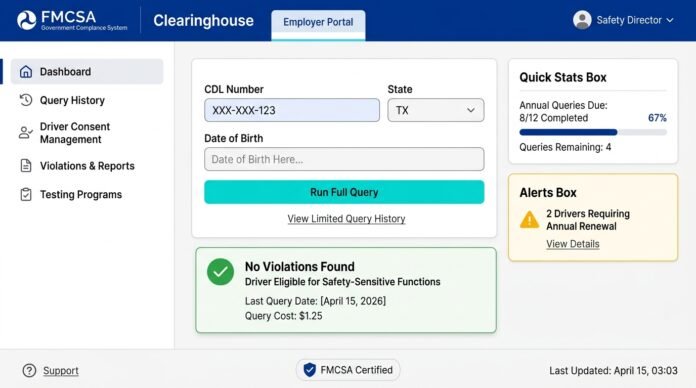


The FMCSA Drug and Alcohol Clearinghouse is a federally mandated database that tracks drug and alcohol violations for all CDL and CLP holders. Since it went live on January 6, 2020, it has fundamentally changed how carriers hire drivers and how violations follow a driver’s career.
If you’re a CDL holder, a motor carrier, or anyone involved in commercial driver hiring, understanding the DOT drug test requirements and the Clearinghouse process isn’t optional. This guide covers what the Clearinghouse contains, how employer query requirements work, what the 5-panel test screens for, and the complete return-to-duty process after a violation.
What the FMCSA Drug and Alcohol Clearinghouse Is
The Clearinghouse is a secure online database that gives employers, the Federal Motor Carrier Safety Administration, State Driver Licensing Agencies, and State law enforcement personnel real-time information about CDL and CLP holders’ drug and alcohol program violations. It contains records of violations of drug and alcohol prohibitions in 49 CFR Part 382, Subpart B, including positive drug or alcohol test results and test refusals. When a driver completes the return-to-duty process and follow-up testing plan, this information is also recorded in the Clearinghouse.
Before the Clearinghouse existed, a driver with a positive test could move to a new employer without that employer knowing about the violation. That gap is closed. Any carrier that queries the system — which all carriers are now required to do — sees the driver’s complete violation history and current status.
2026 Update — Identity Verification: Starting April 27, 2026, users who register for certain Clearinghouse accounts need to prove their identity using a secure web application. This update applies to new registrations for specific user roles. This change was implemented to address fraudulent account activity and applies to employers, C/TPAs, and other users registering new accounts.

Who Must Register and Use the Clearinghouse
Registration requirements apply to:
Employers (motor carriers): Must register before hiring any CDL driver. Employers must conduct queries, with driver consent, for all prospective CDL drivers, and annually for all currently-employed drivers. Employers must be registered prior to hiring a new driver and before annual queries can be completed.
CDL and CLP holders: Drivers can register to access their own records at no cost. Registration is at clearinghouse. Registering allows drivers to see what employers see when they query the system and to respond to employer query consent requests.
Medical Review Officers (MROs): Must report positive drug test results directly to the Clearinghouse.
Substance Abuse Professionals (SAPs): Must report SAP evaluations and return-to-duty process completions.
Consortia/Third-Party Administrators (C/TPAs): May manage Clearinghouse functions on behalf of employers who designate them.
Employer Query Requirements
There are two types of Clearinghouse queries:
Full query: Provides complete violation details. Requires the driver’s electronic consent before the employer can view results. Used for pre-employment queries.
Limited query: Returns one of two results — “No violation information” or “Violation information exists.” Does not show violation details. Does not require individual driver consent if the employer has a general consent on file. Used for annual queries on current employees.
Pre-employment: Before allowing any CDL driver to operate a CMV, the employer must conduct a full query and receive either a clean result or resolve any identified violations. No exceptions.
Annual: Every current CDL driver must be queried at least once every 12 months. Employers can use the limited query for annual checks.
Using a C/TPA: Carriers may designate a consortium or third-party administrator to manage Clearinghouse queries on their behalf. This is common for small carriers who use drug testing management services.
Failure to query before hiring — or failure to conduct annual queries — is itself a violation under 49 CFR Part 382. The Clearinghouse rule requires FMCSA-regulated employers, medical review officers, substance abuse professionals, consortia/third-party administrators, and other service agents to report to the Clearinghouse information related to violations of the drug and alcohol regulations in 49 CFR Parts 40 and 382.
The DOT 5-Panel Drug Test
The standard DOT drug test for commercial drivers is a urine test that screens for five substances under 49 CFR Part 40:
| Substance | What It Detects |
|---|---|
| Marijuana (THC) | Cannabis metabolites |
| Cocaine | Cocaine and metabolites |
| Opiates | Codeine, morphine, heroin metabolites |
| Amphetamines | Amphetamine, methamphetamine, MDMA |
| Phencyclidine (PCP) | PCP |
The test is urine-based and conducted at a DOT-approved collection site. Specimens are sent to a SAMHSA-certified laboratory. Results are reviewed by a Medical Review Officer (MRO) before being reported to the employer.
Cannabis and state law: State medical or recreational marijuana laws have no effect on the DOT drug testing standard. Cannabis remains a Schedule I controlled substance under federal law. FMCSA regulations operate under federal law. A positive marijuana test has the same consequences as any other positive test regardless of your state’s cannabis laws.
When DOT Drug Testing Is Required
- Pre-employment: Before a driver operates a CMV for a new employer
- Random: Carriers must conduct random testing at federally set minimum rates — currently 50% of average driver count annually for drugs, 10% for alcohol
- Post-accident: After crashes meeting specific criteria (fatality, injury requiring immediate medical treatment, or vehicle towed from scene)
- Reasonable suspicion: When a trained supervisor observes behaviors indicating possible impairment
- Return-to-duty: After completing the SAP process following a violation
- Follow-up: After returning to duty, a series of additional tests as specified by the SAP

What Counts as a Violation in the Clearinghouse
The following are recorded violations under 49 CFR Part 382, Subpart B:
- Positive drug test result (confirmed by MRO)
- Positive alcohol test result (0.04 BAC or higher)
- Refusal to submit to a required test
- Adulterating or substituting a specimen
- Alcohol test result of 0.02–0.039 (not a violation itself, but requires driver removal from safety-sensitive functions for 24 hours)
- On-duty alcohol use (any amount)
- Pre-duty alcohol use within 4 hours of coming on duty
Test refusal is treated as a positive test. Attempting to substitute a specimen, arriving at a collection site with a device intended to defeat a test, or leaving a collection site without completing testing are all refusals. The consequences are identical to a positive result.
Consequences of a Positive Test or Violation
Immediate consequences upon a violation being reported:
Removal from safety-sensitive functions: The driver cannot operate a CMV, dispatch, or perform any safety-sensitive function. This is immediate upon the employer receiving notice. There is no grace period.
“Prohibited” status in the Clearinghouse: CDL and CLP holders that have a “prohibited” status in FMCSA’s CDL Drug and Alcohol Clearinghouse will lose their commercial driving privileges until the driver completes the return-to-duty process.
State Driver Licensing Agency notification: FMCSA transmits prohibited status to state DMVs, which may take action on the driver’s CDL under state law.
Employer notification requirement: The employer must immediately notify the driver and remove them from safety-sensitive functions.
The Return-to-Duty Process
A driver with a Clearinghouse violation cannot return to operating a CMV until completing the full return-to-duty process. There are no shortcuts.
Step 1: Substance Abuse Professional (SAP) Evaluation
The driver must be evaluated by a DOT-qualified Substance Abuse Professional. The SAP assesses the driver, identifies an appropriate education or treatment program, and recommends a course of action.
The SAP is not chosen by the employer — the driver selects their own SAP from a list of qualified providers. FMCSA maintains a SAP referral resource at fmcsa.
Step 2: Education or Treatment
The driver completes whatever program the SAP prescribes. This varies based on the violation and the individual’s circumstances. It could range from educational sessions to formal treatment. The driver must fully complete the prescribed program.
Step 3: SAP Follow-Up Evaluation
After completing the program, the driver returns to the SAP for a follow-up evaluation. The SAP determines whether the driver has complied with the treatment recommendations and is ready to return to duty.
Step 4: Return-to-Duty Test
Before returning to safety-sensitive functions, the driver must pass a directly observed return-to-duty drug or alcohol test. The test is directly observed — the collection is witnessed to prevent substitution or adulteration.
Step 5: Follow-Up Testing Plan
The SAP specifies a follow-up testing plan — additional tests conducted after the driver returns to work. Under 49 CFR Part 40.307, the minimum is at least 6 unannounced tests in the first 12 months following return to duty. The SAP may require more tests over a longer period (up to 60 months).

Clearinghouse Record Update
The SAP reports each step of the process to the Clearinghouse. When the driver completes the return-to-duty test and the SAP documents compliance, the Clearinghouse record is updated. Employers querying the system can see that the violation occurred and that the return-to-duty process was completed.
How Long Violations Stay in the Clearinghouse
Drug and alcohol violations remain in the Clearinghouse for five years from the date of the violation, or until the driver completes the return-to-duty process — whichever is later. If a driver never completes the return-to-duty process, the violation remains indefinitely.
This five-year visibility affects every employer who queries the system during that period. A completed return-to-duty process doesn’t erase the violation — it updates the record to show completion. Employers can see both the violation and the resolution.
Random Testing Program Requirements for Carriers
Every FMCSA-regulated carrier must maintain a DOT random drug and alcohol testing program. The current minimum annual testing rates set by FMCSA are:
- Drug testing: 50% of the average number of driver positions per year
- Alcohol testing: 10% of the average number of driver positions per year
FMCSA reviews industry-wide positivity rates annually and can adjust these minimums. Selection must be genuinely random — every driver in the pool has an equal chance of being selected each time.
Small carriers (fewer than approximately 50 drivers) often participate in a consortium random testing pool managed by a C/TPA. The consortium combines multiple small carriers into a single pool to ensure valid statistical randomness.
Pros and Cons of the Clearinghouse System
| Perspective | Pros | Cons |
|---|---|---|
| Driver | Own record accessible; SAP completion documented | Violations visible to all querying employers for 5 years |
| Employer | Pre-employment history verified; reduces liability | Query requirement adds administrative step to hiring |
| Industry | Closes the between-employer gap; uniform enforcement | Compliance cost for small carriers managing queries |
Frequently Asked Questions
A positive test puts your Clearinghouse status as “prohibited” and triggers state DMV notification, which may affect your CDL under state law. The federal consequence is removal from safety-sensitive functions until the return-to-duty process is complete. Your CDL itself may or may not be separately affected depending on your state’s response to a prohibited status notification.
No. Prohibited status is tied to your CDL, not your current employer. Any carrier that queries the Clearinghouse before hiring you will see the prohibited status and cannot legally allow you to operate a CMV.
SAP evaluations typically cost $200–$500. Treatment program costs vary widely based on what the SAP prescribes — from a few hundred dollars for education programs to several thousand for formal treatment. These costs are generally the driver’s responsibility, not the carrier’s.
No. The violation record remains for five years. Completing the process updates the record to show RTD completion — it doesn’t remove the original violation entry. Employers who query will see both the violation and the completion status.
Yes. Alcohol test results of 0.04 BAC or higher and alcohol test refusals are reported to the Clearinghouse and follow the same return-to-duty process as drug violations.
