

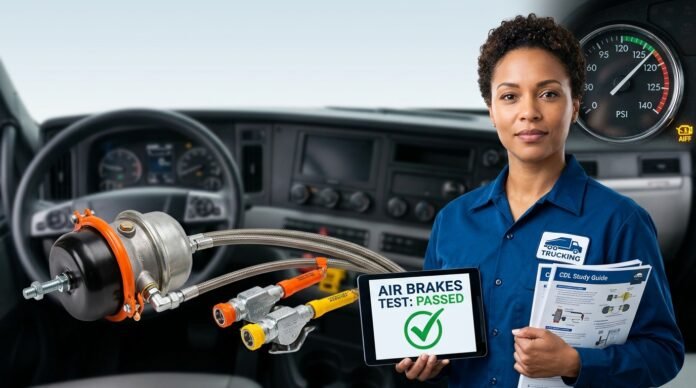


The air brakes knowledge test and the combination vehicles test are two of the more technical written exams in the CDL process. They cover pneumatic systems, brake physics, and the handling characteristics of multi-unit vehicles — topics that are genuinely more complex than the general knowledge test.
If you take your CDL skills test in a vehicle without air brakes, your license gets an “L” restriction that prohibits you from operating air brake-equipped vehicles. That restriction eliminates most tractor-trailers, many Class B trucks, and a wide range of commercial equipment. Passing the air brakes knowledge test removes the restriction.
This guide covers what you need to know for the CDL air brakes and combination vehicles tests in 2026 — the core concepts, key components, and what the test actually covers.
What the Tests Cover and How They Work
The air brakes test and combination vehicles test are separate written examinations administered at your state DMV. You can take them along with your general knowledge test when applying for your CLP, or you can add them later.
Passing score: Most states require 80% or higher — typically 20 out of 25 questions correct. Check your specific state’s requirement before testing since a small number of states use slightly different thresholds.
ELDT connection: If you obtained your CLP on or after February 7, 2022, Entry-Level Driver Training (ELDT) requires theory instruction on air brakes and combination vehicles before your skills test if you’re applying for a Class A CDL. The knowledge tests and ELDT are separate requirements — passing the knowledge test doesn’t satisfy the ELDT requirement, and completing ELDT doesn’t replace the knowledge test.
Study materials come from your state CDL manual, which incorporates the FMCSA model curriculum. Download your state’s current manual from your state DMV website. It covers every topic that appears on the tests and is updated when FMCSA changes its standards.
Air Brake System: Core Components to Know
The air brake system replaces the hydraulic brakes on passenger vehicles with a pneumatic system that uses compressed air to apply braking force. Understanding the system means understanding each component and what it does.
Air Compressor
The air compressor is driven by the engine (via belt or gear) and pumps air into the storage tanks. It runs continuously when the engine is running, building and maintaining system pressure.
The compressor cycles on and off based on system pressure — the governor controls this cycle. When pressure drops below the cut-in pressure (typically around 100 psi), the compressor starts pumping. When pressure reaches the cut-out pressure (typically around 125 psi), the governor cuts off the compressor.
Governor
The governor controls the air compressor’s cut-in and cut-out pressure levels. It’s what prevents the system from being either over- or under-pressurized. If the governor fails, the compressor either runs continuously (causing over-pressure) or stops functioning (causing pressure loss).
Air Storage Tanks (Reservoirs)
Compressed air is stored in tanks — typically at least one supply tank and one or more service tanks. The storage provides reserve pressure so the brakes can be applied multiple times without the compressor running.
Tanks have drain valves at their lowest points. Water accumulates in compressed air systems through condensation. Water in brake lines can freeze in cold weather, causing brake failure. Tanks should be drained daily (or automatically via automatic drain valves) to remove accumulated moisture.

Safety Valve (Relief Valve)
A one-way pressure relief valve protects the system from over-pressurization if the governor fails. It opens automatically if pressure exceeds the safe threshold — typically around 150 psi on most systems.
Brake Chambers and S-Cam Foundation Brakes
Air pressure is applied to brake chambers — cylindrical devices that convert air pressure into mechanical force. The brake chamber pushes a rod that turns the S-cam, which pushes the brake shoes against the brake drum.
For the test, understand the sequence: air pressure → brake chamber → pushrod → slack adjuster → S-cam → brake shoes → drum.
Spring Brakes (Emergency/Parking Brakes)
In commercial vehicles, the parking and emergency brake system uses spring brakes — large springs that apply the brakes mechanically when air pressure is released. This is the opposite of the service brake system.
Spring brakes are applied by releasing air pressure (the spring pushes the brake on) and released by building air pressure (compressing the spring). This design means if the air system fails catastrophically, the brakes engage automatically — a fail-safe mechanism.
The spring brake threshold varies by system but generally engages when reservoir pressure drops to around 20–45 psi.
Brake Pedal (Foot Valve)
The foot valve (brake pedal) controls how much air flows from the reservoir to the brake chambers. Partial pedal application creates partial braking; full application creates maximum braking. Unlike a hydraulic system, the pedal controls airflow to the chambers rather than directly pushing fluid.
Supply Lines and Service Lines (on combination vehicles)
On combination vehicles, the tractor supplies air to the trailer through two lines:
The supply line (emergency line) — typically red — provides air to charge the trailer reservoir and holds the trailer’s spring brakes released during normal operation.
The service line (control line) — typically blue — carries the braking signal from the tractor foot valve to the trailer brake chambers.
Trailer connection is through glad hands — coupling devices that connect tractor air lines to trailer air lines. The coupling orientation is keyed to prevent cross-connecting supply and service lines.

Key Air Brake Concepts for the Test
Normal Operating Pressure
Most air brake systems operate between 100–125 psi during normal operation. The compressor governor maintains this range. Below 60 psi, a low pressure warning (buzzer and/or light) activates. At around 20–45 psi, spring brakes apply.
Brake Lag
Air brakes have a slight delay between applying the pedal and full braking force being developed — this is brake lag, caused by the time required for air to travel through the lines to the brake chambers. The typical brake lag on a well-maintained system is approximately 0.4 seconds.
Brake lag is part of why following distance requirements for large trucks are greater than for passenger vehicles. At highway speeds, that fraction of a second represents significant distance.
Brake Fade
Heat buildup during extended braking (descending long grades) reduces braking effectiveness — this is brake fade. The solution for long descents is to use engine braking and retarders to control speed before braking, rather than riding the service brakes continuously. Using the service brakes to control speed on a long grade overheats them, reducing effectiveness exactly when you need it most.
Proper Braking Procedure
For emergency braking on a vehicle without anti-lock brakes: apply firm, continuous pressure. Avoid pumping. Modern air brake systems with ABS should receive continuous firm pressure — ABS handles the anti-lock function automatically.
Brake Adjustment
Air brake adjustment is critical to brake effectiveness. Automatic slack adjusters are now standard and adjust brake push rod travel automatically. But auto adjusters can fail or mask wear. Pre-trip inspection includes checking brake adjustment for each wheel position. Improperly adjusted brakes are a leading cause of roadside out-of-service orders. Our Pre-Trip Inspection guide covers the pre-trip brake check procedure.
Combination Vehicle Concepts
The combination vehicles test covers topics that apply specifically to multi-unit trucks — articulated vehicles, doubles, and triples.
Trailer Offtracking
When a combination vehicle turns, the trailer’s rear wheels don’t follow the same path as the front wheels — they cut inside the curve. This is called offtracking. The longer the combination, the more pronounced the offtracking.
In a tight turn, a 53-foot trailer’s rear wheels can track significantly inside the front wheels’ path. This affects how wide turns need to be made and how close the trailer can safely pass obstacles on the inside of a turn.
Rearward Amplification
In doubles and triples, the rear trailer swings more than the front trailer during an emergency maneuver. This “crack the whip” effect means that a maneuver that the tractor handles safely can generate dangerous forces at the rear of the combination. Operating doubles and triples requires extra smoothness in steering and braking inputs.
Jackknife Prevention
A jackknife occurs when the trailer overruns the tractor — typically because the trailer brakes are applying more force than the tractor brakes, or because the tractor steers away from the trailer during hard braking. Preventing jackknife involves:
- Proper brake adjustment on all axles
- Avoiding hard braking on slippery surfaces
- Not braking and steering sharply simultaneously
If a jackknife begins, gradually releasing the brake pressure on the trailer (if controlled separately) can allow the trailer to straighten. ABS significantly reduces jackknife risk.
Coupling Procedure
The correct coupling sequence matters for the test and for real-world safety. The core steps:
- Inspect fifth wheel — it must be tilted down at the rear, jaws open, and properly greased
- Back under the trailer — the fifth wheel should contact the trailer kingpin and slide under
- Check coupling is secure — attempt to pull forward with the trailer brakes locked; the trailer should not release from the tractor
- Connect glad hands (supply first, then service) and electrical
- Raise landing gear
- Inspect for proper coupling height and clearance
An improperly coupled trailer can separate at speed — one of the most dangerous situations on a highway. The physical pull-test after coupling is not optional.

Pre-Trip Inspection for Air Brake Components
The pre-trip test requires you to identify and inspect air brake components. Know where these are located on your specific vehicle:
- Air compressor (in engine compartment)
- Air tanks and drain valves
- Low pressure warning indicator
- Spring brake controls
- Brake chambers (under vehicle, at each axle)
- Slack adjusters
- Brake drums and linings (as accessible)
- Glad hands and air lines on combination vehicles
The pre-trip requires you to verbally explain what you’re checking and why — not just point at components. Know the normal operating range for each system you inspect.
Test Preparation Approach
The state CDL manual covers everything tested. Read the air brakes and combination vehicles chapters thoroughly — not just the summaries. The questions test specific values (pressure ranges, lag times) as well as concepts.
Practice tests are available through state DMV websites and commercial CDL prep apps. These give you a sense of question format and which concepts appear most frequently.
Common test mistakes:
- Confusing the supply line and service line color codes (red vs. blue)
- Getting the spring brake pressure threshold wrong
- Misidentifying what the governor controls
- Confusing brake lag time values
Read the question completely before answering. Air brake and combination vehicle questions sometimes include distractors that are plausible but incorrect.
Frequently Asked Questions
The L restriction prohibits the holder from operating any commercial vehicle equipped with air brakes. It’s added to your CDL if you take the skills test in a vehicle without air brakes. To remove it, pass the air brakes knowledge test at your state DMV.
Passing both tests is effectively required if you want to operate standard Class A equipment, which almost universally uses air brakes and involves combination vehicles. Technically, you could hold a Class A CDL with an L restriction, but you couldn’t drive most Class A equipment. In practice, removing the L restriction is part of the Class A licensing process for virtually all applicants.
Most states administer 25 questions per section. The passing threshold is typically 80% — 20 correct. Verify your state’s specific requirements since a small number of states vary.
Generally yes. Failing one knowledge section doesn’t invalidate other sections you’ve already passed. Check your state’s specific retesting policy — waiting periods between retests vary by state, typically 24 hours to one week.
Many Class B vehicles use air brakes (buses, dump trucks, straight trucks). If you want to operate Class B air brake vehicles, you need to pass the air brakes knowledge test to remove the L restriction, same as Class A.