
...
16.5 C
London
HomeDOT ComplianceDOT Drug Test & Clearinghouse 2026: 5-Panel, SAP & Complete Guide

DOT Drug Test & Clearinghouse 2026: 5-Panel, SAP & Complete Guide

Recently In 2026, a long-haul driver in Pennsylvania lost his CDL, his job, and faced a $5,470 civil penalty—not because he failed a drug test, but because his employer failed to query the Clearinghouse before hiring him. The FMCSA doesn’t care whose fault it is. Both driver and carrier paid the price.

Table of Contents

The DOT drug test Clearinghouse isn’t optional anymore. It’s the backbone of every hiring decision, random screening program, and return-to-duty protocol in the trucking industry. Since its 2020 launch, the database has flagged over 187,000 violations. As of April 2026, compliance rates hover near 94%, but that remaining 6% represents thousands of carriers risking registration revocation and drivers stuck in employment limbo.

This guide breaks down the 5-panel test, Clearinghouse query requirements, Substance Abuse Professional (SAP) protocols, and the precise steps to stay compliant—or return to work after a violation. Whether you’re a first-time CDL holder or a fleet manager running 200 trucks, understanding this system protects your license, your livelihood, and your legal standing.

    KEY TAKEAWAYS
  • The DOT drug test Clearinghouse tracks all positive tests, refusals, and SAP completions for commercial drivers.
  • Employers must run pre-employment queries and annual full queries on every CDL driver.
  • The 5-panel urine test screens for marijuana, cocaine, opiates, amphetamines, and PCP.
  • A positive result triggers immediate removal from safety-sensitive functions and requires SAP evaluation.
  • Drivers cannot work until completing the SAP return-to-duty process and passing a follow-up test.
  • Clearinghouse violations stay visible for five years, but completion of SAP protocols shows on records immediately.

What Is the DOT Drug Test Clearinghouse?

The DOT Drug and Alcohol Clearinghouse is a federally mandated database operated by the FMCSA. It records all drug and alcohol violations for holders of commercial driver’s licenses. Employers, medical review officers, third-party administrators, and SAP counselors report violations directly to the system. The database became fully operational on January 6, 2020, and compliance became mandatory for all motor carriers operating under FMCSA jurisdiction.

Every positive drug test, alcohol test refusal, and SAP process completion gets logged. The system provides real-time visibility into a driver’s violation history. Before the Clearinghouse, drivers could move between companies and hide past failures. Now, transparency is enforced at the federal level.

The Clearinghouse applies to anyone requiring a CDL to perform safety-sensitive functions. This includes:

  • Interstate and intrastate truck drivers
  • Bus operators
  • School bus drivers in certain states
  • Any driver operating a vehicle over 26,001 pounds GVWR
  • Vehicles designed to transport 16+ passengers
  • Drivers hauling hazardous materials requiring placards

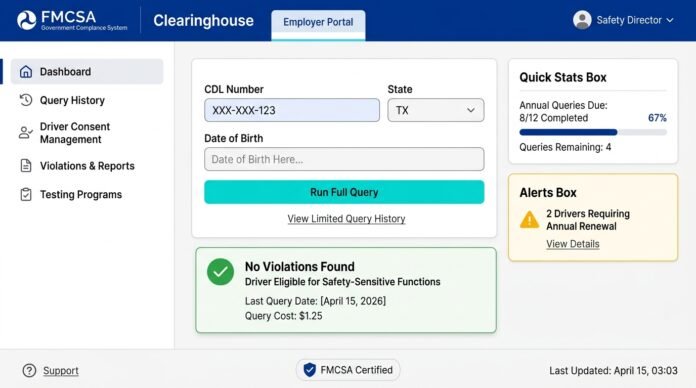
Employers must query the database before hiring and annually for current employees. Missing a query can result in civil penalties up to $7,914 per violation as of 2026. For carriers with large fleets, the financial exposure adds up fast.

DOT drug test Clearinghouse process flowchart showing employer query, positive test, SAP evaluation, and return-to-duty steps for commercial drivers in 2026

The 5-Panel DOT Drug Test Explained

The DOT drug test uses a standardized 5-panel urine screen. It’s not a hair test, saliva test, or expanded panel. The FMCSA specifies exactly which substances get tested. The five drug categories are:

Drug Class Substances Detected Cutoff Level (ng/mL)
Marijuana (THC) Delta-9-tetrahydrocannabinol metabolites 50
Cocaine Benzoylecgonine metabolite 150
Opiates Codeine, morphine, heroin (6-AM) 2,000
Amphetamines Amphetamine, methamphetamine 500
Phencyclidine (PCP) Phencyclidine 25

Why Only 5 Panels?

The Department of Transportation hasn’t expanded the panel to include synthetic opioids like fentanyl, despite industry lobbying. The 5-panel standard remains locked in 49 CFR Part 40. Some carriers run additional non-DOT tests, but those results don’t count for federal compliance.

Prescription medications can trigger positives. If you take Adderall, oxycodone, or codeine-based cough syrup, you must disclose it to the Medical Review Officer (MRO) during the verification process. The MRO reviews your prescription and determines whether the positive is legitimate. If verified as a lawful prescription, the test gets marked negative.

Collection Procedures

DOT tests follow strict chain-of-custody rules. The collector must:

  • Verify photo ID
  • Seal specimens in tamper-evident containers
  • Ship to a SAMHSA-certified lab
  • Document every transfer

Observed collections only happen after a refusal, adulteration attempt, or return-to-duty test. Random and pre-employment tests are unobserved unless the driver provides insufficient volume.

Drivers have three hours to provide a 45mL sample. If you can’t produce enough urine, the collector gives you up to 40 ounces of water. Failure to provide a sample within three hours without a valid medical reason counts as a refusal, which carries the same penalties as a positive test.

How Employers Must Use the Clearinghouse

Employers have two types of query obligations: pre-employment and annual.

Pre-Employment Queries

Before allowing a driver to operate a CMV, the employer must conduct a full query of the Clearinghouse. This reveals:

  • Any unresolved drug or alcohol violations
  • Whether the driver is prohibited from performing safety-sensitive functions
  • SAP completion status

Driver consent is required. The driver must log into the Clearinghouse and grant electronic consent. Without it, the employer cannot run the query, and the driver cannot be hired.

If the query shows a violation, the employer cannot hire the driver until:

  1. The driver completes the SAP return-to-duty process
  2. The driver passes a return-to-duty test
  3. The SAP confirms the driver is eligible to work

Annual Full Queries

Every year, employers must run full queries on all active drivers. The deadline is within 12 months of the previous query. Most carriers batch these in January to simplify compliance tracking.

Annual queries catch violations that occurred while the driver worked elsewhere. A driver might fail a random test at a previous employer, leave before the SAP process completes, then apply at your company. The annual query flags this.

Limited Queries (Real-Time Monitoring)

Employers can also conduct limited queries at any time. These show whether the Clearinghouse contains any information about a driver but don’t reveal details. Limited queries help monitor active employees between annual checks.

If a limited query shows a record exists, the employer must request the driver’s consent for a full query. Drivers can refuse, but refusal triggers immediate removal from safety-sensitive duties pending resolution.

Employer Reporting Obligations

Employers must report violations within two business days of learning about them. This includes:

  • Positive drug tests
  • Positive alcohol tests (≥0.04 BAC or ≥0.02 during post-accident)
  • Test refusals
  • SAP evaluations and treatment completions

Failure to report carries civil penalties starting at $1,983 per violation. The FMCSA audits Clearinghouse compliance during DOT compliance truck inspections and registration reviews.

What Happens After a Positive DOT Drug Test?

A positive result triggers immediate consequences. The driver gets removed from all safety-sensitive functions the same day the MRO reports the verified positive.

Step 1: MRO Notification

The Medical Review Officer contacts the driver within 72 hours. The driver has the chance to explain the positive. Valid prescriptions or documented medical conditions may change the result. If the MRO confirms the positive, they report it to the employer and the Clearinghouse.

Step 2: Immediate Removal

The employer must remove the driver from all CMV operations. You cannot drive, dispatch, load, or perform any safety-sensitive work. This removal is non-negotiable. Employers who allow drivers to work after a positive face severe DOT fines and potential criminal liability if an accident occurs.

Step 3: SAP Referral

The employer must provide the driver with a list of qualified Substance Abuse Professionals. The driver contacts the SAP to begin evaluation. The employer is not required to pay for the SAP process, but some union contracts or company policies cover costs.

Step 4: SAP Evaluation

The SAP conducts a face-to-face assessment. They evaluate:

  • Substance use history
  • Mental health factors
  • Risk of future violations
  • Appropriate treatment or education

The SAP then prescribes a treatment plan. This might include:

  • Outpatient counseling (8-12 sessions typical)
  • Inpatient rehabilitation (28-90 days)
  • Aftercare monitoring (12-60 months)
  • Education programs (minimum 6 hours)

The driver must complete every requirement the SAP prescribes. Partial completion doesn’t count.

Step 5: Follow-Up Evaluation

After finishing treatment, the driver returns to the SAP. The SAP determines whether the driver successfully met all requirements and is safe to return to duty. If yes, the SAP issues a return-to-duty recommendation.

Step 6: Return-to-Duty Test

The driver must pass an observed return-to-duty drug test. This is a 5-panel urine test with direct observation. A negative result allows the driver to return to work.

Step 7: Follow-Up Testing Plan

The SAP designs a follow-up testing plan lasting 12-60 months. The driver faces at least six unannounced tests in the first year. Tests can be drug, alcohol, or both. The employer must follow the SAP’s schedule exactly.

The driver remains in the Clearinghouse with a “completed SAP process” notation. The violation stays visible for five years, but the SAP completion shows immediately, signaling to future employers that the driver followed protocol.

Step-by-step timeline of DOT Substance Abuse Professional process for commercial drivers after positive drug test Clearinghouse violation in 2026

Understanding SAP Requirements and Costs

Substance Abuse Professionals must hold specific credentials. The DOT recognizes:

  • Licensed physicians (MD or DO)
  • Licensed or certified social workers
  • Licensed or certified psychologists
  • Licensed or certified employee assistance professionals
  • State-licensed or certified addiction counselors

The SAP must also complete specialized DOT training and maintain knowledge of 49 CFR Part 40.

What SAPs Do (and Don’t Do)

SAPs evaluate and recommend treatment. They do not provide the treatment themselves. A conflict of interest exists if the SAP refers you to their own clinic or receives kickbacks from treatment centers.

SAPs also don’t advocate for you with employers. Their job is to determine fitness for duty, not to help you keep your job.

Cost Breakdown

SAP processes aren’t cheap. Expect these ranges as of 2026:

Service Typical Cost Range
Initial SAP Evaluation $400 – $800
Outpatient Counseling (per session) $75 – $200
Intensive Outpatient Program (IOP) $3,000 – $10,000
Inpatient Rehabilitation (28 days) $5,000 – $30,000
Follow-Up SAP Evaluation $300 – $600
Return-to-Duty Drug Test $85 – $150
Follow-Up Tests (6-60 months) $500 – $3,000 total

Total out-of-pocket costs range from $4,500 to over $45,000 depending on severity and treatment length. Some health insurance plans cover portions, but DOT-specific SAP fees often aren’t reimbursed.

Drivers typically face 4-8 months out of work during the SAP process. Lost income compounds the financial burden. A driver earning $65,000 annually loses roughly $22,000-$43,000 in wages during this period.

Finding a Qualified SAP

The FMCSA doesn’t maintain an official SAP directory. You must:

  1. Search online for “DOT qualified SAP near me”
  2. Verify credentials on your state’s licensing board
  3. Confirm DOT-specific training completion
  4. Check reviews from other drivers

Avoid SAPs who guarantee quick returns or promise to minimize treatment. The process takes as long as it takes.

Refusal to Test: The Worst-Case Scenario

Refusing a DOT drug or alcohol test carries identical penalties to a positive result. The Clearinghouse records it the same way. Employers must remove you immediately, and you must complete the full SAP process.

What Counts as a Refusal?

Under 49 CFR Part 40, refusals include:

  • Failing to provide sufficient urine within three hours without valid medical reason
  • Failing to submit to testing when directed
  • Leaving the collection site before testing completes
  • Adulterating or substituting a specimen
  • Refusing to sign required forms
  • Failing to cooperate with observed collections
  • Failing to follow observer instructions during direct observation

Adulteration attempts are common refusals. Adding water to the cup, using synthetic urine, or drinking excessive fluids to dilute the sample all count as refusals. Labs test for specific gravity, creatinine, and pH. Abnormal results trigger recollection under observation.

Shy Bladder Situations

If you genuinely cannot provide 45mL of urine, the collector gives you up to 40 ounces of water and three hours. If you still can’t produce a sample, you must get evaluated by a physician within five days. The doctor determines whether a medical condition prevents urination.

If no medical condition exists, it’s a refusal. If a condition is documented, the test gets canceled and you typically face a re-test using a different method or extended time.

Legal Consequences of Refusal

Beyond employment termination and SAP requirements, refusals can trigger:

Some states impose additional penalties through their CDL programs. New York, California, and Texas treat DOT test refusals as serious violations that can add points to your license suspension risk.

Clearinghouse Registration: Driver and Employer Steps

Both drivers and employers must register in the Clearinghouse. Registration is free but requires specific documentation.

Driver Registration

  1. Go to clearinghouse.fmcsa.dot.gov
  2. Click “Register” and select “Driver”
  3. Provide your CDL number, state of issuance, and DOB
  4. Create a Login.gov account if you don’t have one
  5. Verify identity using ID.me (requires photo ID and selfie)
  6. Complete the registration form

Once registered, you can:

  • Grant consent to employers for queries
  • View your own Clearinghouse record
  • Revoke consent from previous employers
  • Receive notifications when queries occur

Drivers must maintain active consent for current employers. If you revoke consent without reason, your employer must immediately remove you from safety-sensitive functions.

Employer Registration

Employers register as a company, not individuals. The registration requires:

  1. USDOT number (active and valid)
  2. Business legal name and address
  3. FEIN (Federal Employer Identification Number)
  4. Designated Employer Representative (DER) information

The DER manages queries and reports violations. Most companies designate their safety director or compliance officer. Larger carriers may have multiple DERs.

Employers pay $1.25 per full query and $1.00 per limited query as of 2026. Pre-payment through bulk credits is available.

Third-Party Administrator Access

Many carriers use TPAs to manage drug testing programs. TPAs must register separately and receive delegated access from the employer. The employer remains ultimately responsible for compliance even when using a TPA.

FMCSA DOT drug test Clearinghouse driver portal showing employer consent management for CDL holders in 2026

Random Testing Requirements and Clearinghouse Impact

Random testing is mandatory for all carriers with CDL drivers. The FMCSA sets minimum annual testing rates:

  • 50% of drivers for drugs (2026 rate)
  • 10% of drivers for alcohol (2026 rate)

These percentages apply to the average number of drivers, not individual testing frequency. A company with 100 drivers must conduct at least 50 random drug tests and 10 random alcohol tests annually.

Random Selection Process

Selections must be truly random using a scientifically valid method. Most carriers use software that generates random lists. Manual “random” selections open you to discrimination claims.

Every driver has an equal chance of selection each time. You can be tested multiple times in one year or go years without selection. That’s statistically normal.

Testing Windows

Random tests must be unannounced. Drivers get notified immediately before the test. You must proceed to the collection site right away. The only acceptable delays are:

  • Completing a current delivery (not starting a new one)
  • Parking the CMV safely
  • Emergency situations

Delaying more than a few hours can be considered refusal.

Clearinghouse Reporting

Every random positive gets reported to the Clearinghouse. The system tracks testing rates and violation rates by carrier. FMCSA uses this data to adjust industry-wide testing percentages and target enforcement.

Carriers with high violation rates face increased scrutiny during DOT compliance audits. Patterns of violations can trigger investigations into inadequate testing programs or falsified records.

State-Specific Clearinghouse Integration

While the Clearinghouse is federal, states integrate it differently into their CDL programs.

Automatic CDL Suspensions

Some states automatically suspend your CDL when a Clearinghouse violation appears. Others require employers or courts to report separately. As of April 2026:

States with Automatic Suspension:

  • California
  • Texas
  • New York
  • Florida
  • Pennsylvania
  • Ohio

States Requiring Separate Reporting:

  • Montana
  • Wyoming
  • Vermont
  • New Hampshire

Check your state’s CDL manual for specific procedures. Suspension timelines vary from immediate to 30 days after violation.

Reinstatement Procedures

Completing the SAP process and getting Clearinghouse clearance doesn’t automatically reinstate your state CDL. You must:

  1. Pay reinstatement fees ($50-$500 depending on state)
  2. Retake knowledge or skills tests (in some states)
  3. Provide proof of SAP completion
  4. Show negative return-to-duty test results

New York requires a defensive driving course. California mandates a DMV hearing for some violations. Texas adds a $100 administrative fee on top of standard reinstatement costs.


Owner-Operators and Clearinghouse Compliance

Owner-operators face unique challenges. You’re both the employer and the driver. You must register twice in the Clearinghouse: once as a driver, once as a company.

Self-Query Requirements

As the employer, you must conduct annual queries on yourself. This seems redundant but it’s required. Set a calendar reminder 12 months from your USDOT activation or previous query.

Consortium/TPA Services

Most owner-operators join a drug testing consortium. These companies handle:

  • Random selection pools
  • Collection site coordination
  • MRO services
  • Clearinghouse reporting

Costs run $150-$400 annually plus per-test fees. When choosing a consortium, verify they:

  • Have 24/7 notification availability
  • Use certified collection sites
  • Integrate directly with the Clearinghouse
  • Provide compliance documentation

Never join a consortium that promises to “minimize” your testing chances. That’s a violation waiting to happen.

Leased Driver Complications

If you lease your truck to a carrier, both you and the carrier have testing obligations. The lease agreement should specify who conducts randoms, pre-employment tests, and post-accident screening.

Dual queries can occur. The leasing carrier queries you when you join their fleet. Your own USDOT company also requires annual queries. Both show in the Clearinghouse, but driver consent is needed for each.

Post-Accident Testing and Clearinghouse Entries

Post-accident testing is required after accidents meeting specific criteria. The employer must test when:

  • A fatality occurs
  • The driver receives a citation AND someone required medical treatment away from the scene
  • The driver receives a citation AND a vehicle was towed from the scene

Testing must occur within 2 hours for alcohol and 32 hours for drugs. The Clearinghouse records any positives from post-accident tests.

What If Testing Is Delayed?

If you can’t complete testing within the required window (due to hospitalization or other valid reasons), the employer must document the reason and test as soon as possible. Tests conducted beyond 8 hours for alcohol lose evidentiary value for violations but must still be attempted and documented.

Positive Post-Accident Results

A positive post-accident test doesn’t automatically mean the driver caused the accident. It means the driver had a prohibited substance in their system. Liability for the accident gets determined separately through accident investigation and legal proceedings.

However, the Clearinghouse violation stands regardless of fault. The driver still faces removal and must complete the SAP process.

Post-accident positives often trigger additional consequences:

  • Employer insurance claims complications
  • Personal liability exposure
  • Criminal charges if impairment contributed to injury or death
  • Permanent employment barriers at many carriers

Privacy Protections and Driver Rights

The Clearinghouse includes privacy safeguards, but transparency is the primary goal.

What Information Is Stored?

The database contains:

  • Driver name, CDL number, and state
  • Violation dates and types
  • SAP contact information (if applicable)
  • Treatment completion dates
  • Return-to-duty test results
  • Follow-up testing plans

The Clearinghouse does not store:

  • Specific drug amounts or levels
  • Medical information beyond SAP completion
  • Reasons for testing (except type: random, post-accident, etc.)
  • Financial information
  • Employment history

Who Can Access Your Information?

Only authorized parties can query your record:

  • Employers (with your consent)
  • FMCSA enforcement personnel
  • State licensing agencies (in some states)
  • You (viewing your own record)

Employers from five years ago cannot query you unless you grant consent. Consent expires when you leave a company or revoke it.

Correcting Errors

If you believe your Clearinghouse record contains errors, you must contact the entity that reported the information (usually the employer or MRO). They investigate and correct legitimate errors.

The FMCSA doesn’t change records directly except in cases of proven identity theft or system errors. Disputes over whether a test was truly positive go through the MRO review process outlined in 49 CFR Part 40, not through the Clearinghouse.

FOIA and Background Checks

The Clearinghouse is exempt from Freedom of Information Act requests for individual driver records. Consumer reporting agencies (background check companies) cannot access it. Only DOT-authorized queries are permitted.


Clearinghouse Violations and License Disqualifications

How long do violations stay on record? Clearinghouse entries remain visible for five years from the violation date. However, SAP completion appears immediately once reported.

Impact on Employment

Most major carriers have zero-tolerance policies. A Clearinghouse violation disqualifies you from employment even if you completed the SAP process. This varies by company, but expect:

  • Mega carriers (100+ trucks): Usually permanent disqualification
  • Mid-size fleets (20-99 trucks): Case-by-case review, often denied
  • Small carriers (<20 trucks): More flexibility, especially with established relationships
  • Owner-operator opportunities: Best chance for re-employment post-SAP

CDL Downgrade Options

Some drivers with violations choose to downgrade to a non-commercial license to work in other industries. The violation stays in the Clearinghouse, but without a CDL you’re not subject to DOT testing in non-CMV jobs.

If you reapply for a CDL later, the five-year clock continues from the original violation date. You’ll need to show SAP completion and may face state-specific retesting.

Building a Driver Qualification File

Employers maintain a driver qualification file for every driver. Clearinghouse queries and results are part of this file. Annual queries ensure ongoing eligibility.

2026 Regulatory Updates and Enforcement Trends

Recent enforcement changes impact how the FMCSA monitors compliance.

Automated Compliance Checks

The FMCSA now cross-references Clearinghouse data with SMS scores and crash reports. Carriers with violations who also have high SMS percentiles face prioritized audits.

Penalty Increases

Civil penalties increased in January 2026 per inflation adjustments:

  • Failure to query before hiring: $7,914 per violation
  • Failure to conduct annual queries: $3,957 per driver per year
  • Failure to report violations: $1,983 per incident
  • Allowing a driver with unresolved violation to operate: $19,785 per instance

One carrier in Ohio faced $476,000 in penalties in March 2026 for allowing 24 drivers with Clearinghouse violations to operate over a six-month period.

Enhanced Data Sharing

As of 2026, the Clearinghouse shares violation data with:

  • State licensing agencies (all 50 states plus DC)
  • Canadian and Mexican authorities for cross-border drivers
  • FMCSA Safety Measurement System
  • Select law enforcement agencies investigating drug trafficking

This integration makes hiding violations virtually impossible.

Clearinghouse for Specialized Endorsements

Certain CDL endorsements face additional scrutiny when Clearinghouse violations appear.

Hazmat Endorsement (H)

The TSA conducts background checks for hazmat endorsements. A Clearinghouse drug violation doesn’t automatically disqualify you from the TSA check, but it raises red flags. You must disclose the violation on your application.

States may deny hazmat renewal until the SAP process completes. Hazmat placards and shipping papers violations combined with drug violations often result in permanent hazmat disqualification.

Passenger Endorsement (P)

School bus and passenger carrier employers almost universally reject drivers with any Clearinghouse history. The liability exposure is too high. Even completing SAP rarely results in rehire in passenger transport.

Tank and Double/Triple Trailers

These endorsements don’t have specific Clearinghouse restrictions beyond standard CDL requirements, but insurance companies scrutinize violation history when underwriting policies.

Insurance Implications of Clearinghouse Violations

Commercial auto insurance rates skyrocket after a Clearinghouse violation. Insurers view drug violations as indicators of high-risk drivers.

Premium Increases

Expect these impacts:

  • First violation: 40-80% premium increase
  • Violation with accident involvement: 100-200% increase
  • Refusal to test: 60-120% increase
  • Multiple violations: Often uninsurable through standard markets

Owner-operators may face policy cancellation. Finding coverage in the surplus lines market costs 3-5 times standard rates.

Policy Exclusions

Some insurers add exclusions for drivers with Clearinghouse violations. The policy might cover the vehicle but not that specific driver. This creates legal and operational complications.

Long-Term Impact

Even after the five-year Clearinghouse window, insurance companies request violation history for the past 7-10 years. Rates may not fully normalize for a decade.

Technology and Clearinghouse Integration

Software solutions now integrate directly with the Clearinghouse to automate compliance.

Fleet Management Systems

Modern TMS and fleet management platforms include:

  • Automatic query scheduling for annual reviews
  • Driver consent request automation
  • Query result alerts
  • Compliance documentation storage
  • Integration with drug testing consortiums

Popular systems include Samsara, Motive (formerly KeepTruckin), and Platform Science.

Mobile Apps

Drivers can manage Clearinghouse consent through mobile apps like:

  • FMCSA’s official Clearinghouse mobile portal
  • TPA-specific apps for consortium members
  • Third-party compliance trackers

These apps send notifications when employers request consent and allow instant approval.

API Access

The FMCSA offers API access for software developers. This allows real-time queries and batch processing for large fleets. API access requires additional registration and security protocols.

International Drivers and Cross-Border Implications

Canadian and Mexican CDL equivalents face similar scrutiny when operating in the US.

CVSA Integration

The Commercial Vehicle Safety Alliance shares Clearinghouse data with Canadian and Mexican authorities. A violation in the US appears in Canadian databases and vice versa.

Cross-Border Operators

Mexican carriers operating under USDOT authority must register in the Clearinghouse and test drivers under US rules when operating in the US. Canadian carriers face similar requirements.

Return-to-Home Country

If you’re a foreign national driver who returns to your home country during a SAP process, you must still complete all US requirements to operate here again. SAP treatment in Canada or Mexico doesn’t satisfy US DOT rules unless the SAP is US-qualified.

Future of the Clearinghouse: Predicted Changes

The FMCSA proposed several expansions expected to take effect in 2027-2028.

Oral Fluid Testing

The Department of Health and Human Services approved oral fluid (saliva) testing as an alternative to urine in 2023. Full implementation into the Clearinghouse is expected by late 2027. Oral fluid has shorter detection windows but can be observed more easily and reduces shy bladder issues.

Hair Testing Recognition

The industry has lobbied for hair testing for years. Hair detects drug use for 90 days versus 2-5 days for urine. However, concerns about racial bias in hair testing have stalled adoption. No definitive timeline exists for FMCSA approval.

Expanded Drug Panels

Some advocate for adding:

  • Synthetic opioids (fentanyl, carfentanil)
  • Benzodiazepines
  • Synthetic cannabinoids (K2, Spice)

The DOT has not committed to expanding the 5-panel standard as of April 2026.

Real-Time Violation Alerts

The FMCSA is developing a system to automatically notify all employers of record when a driver has a new violation. This would eliminate the need for constant limited queries.

Practical Tips: Staying Compliant and Protecting Your CDL

Proactive compliance is the only strategy that works.

For Drivers:

  1. Never use prohibited substances. CBD products, poppy seed bagels, and cold medicine won’t cause positives if used reasonably, but why risk it?
  2. Disclose prescriptions immediately. Tell the MRO about any legitimate medication before the test if possible.
  3. Register in the Clearinghouse so you can monitor your record.
  4. Respond to employer consent requests promptly. Delays can cost you job opportunities.
  5. Understand your rights. You can view your own record anytime and dispute errors through proper channels.
  6. Document everything. Keep copies of all medical records, prescriptions, and SAP completion letters.

For Employers:

  1. Automate query scheduling. Use software to prevent missed annual queries.
  2. Train your DER thoroughly. Clearinghouse reporting errors are common and costly.
  3. Maintain a qualified SAP list. Drivers will ask for recommendations—have vetted resources ready.
  4. Document consent and queries meticulously. Audits focus heavily on query compliance.
  5. Integrate Clearinghouse checks into onboarding. Don’t let new drivers operate until the query returns clean.

Frequently Asked Questions

How long does a DOT drug test stay in the Clearinghouse?

Violations remain visible for five years from the date of the violation. SAP completions appear immediately when reported but don’t erase the violation entry.

Can I get a CDL if I have a Clearinghouse violation?

Yes, but you must complete the SAP return-to-duty process first. You cannot perform safety-sensitive functions until SAP clearance and a negative return-to-duty test.

Do employers have to tell me when they query the Clearinghouse?

For full queries, yes—you must grant consent, so you’re always aware. For limited queries, employers aren’t required to notify you, but the system logs all queries you can view in your account.

What happens if I fail a DOT drug test for marijuana in a state where it’s legal?

Federal law governs DOT testing. Marijuana remains prohibited under 49 CFR Part 40 regardless of state legalization. You face the same consequences as any other positive test.

Can I refuse a random drug test if I’m off duty?

No. As long as you’re in the employer’s random testing pool, you must comply when selected. Off-duty status doesn’t exempt you from DOT testing requirements.

Conclusion: The Clearinghouse Changed Commercial Driving Forever

The DOT drug test Clearinghouse ended the era of job-hopping to escape violations. Transparency protects the driving public and creates accountability. It’s also unforgiving. One mistake costs months of income, thousands of dollars, and potentially your entire career.

Compliance isn’t complicated. Don’t use prohibited substances. Respond to testing requirements immediately. Maintain your Clearinghouse registration and driver consent. If you’re an employer, run queries on time and report violations within two business days.

The system works when everyone follows the rules. The 94% compliance rate shows most drivers and carriers understand the stakes. For the 6% still cutting corners, 2026 enforcement trends make clear: the FMCSA is watching, penalties are rising, and the margin for error is gone.

Your CDL is your livelihood. Treat Clearinghouse compliance with the seriousness it deserves.

Written by the Compliant Drivers Editorial Team
Our team of former DOT compliance officers, CDL instructors, and transportation attorneys provides accurate, up-to-date guidance for commercial drivers and fleet managers. We monitor FMCSA rulemakings, enforcement trends, and industry best practices to deliver reliable compliance information.

Last Updated: April 2026

External References:

This article provides general compliance information and does not constitute legal advice. Consult with a qualified DOT attorney or compliance professional for situation-specific guidance.

Latest Articles

Explore More

LEAVE A REPLY

Please enter your comment!
Please enter your name here