



If you hold a CDL or you’re working toward one, the DOT physical exam is something you’ll deal with every one to two years for your entire driving career. It’s not optional, and it’s not the same as your regular checkup with your family doctor. Understanding exactly what’s required, what examiners look for, and how common health conditions are handled can save you time, money, and a lot of unnecessary stress before your appointment.
This guide covers the DOT physical exam requirements for 2026 — including costs, what happens during the exam, which conditions disqualify you, how sleep apnea and diabetes are handled, and how to keep your medical certificate current.
What Is a DOT Physical Exam?
The DOT physical exam is a federally mandated medical evaluation required for commercial motor vehicle (CMV) drivers operating in interstate commerce. The Federal Motor Carrier Safety Administration establishes the health standards under 49 CFR Part 391, Subpart E — and every certified examiner must follow those standards exactly.
You need a current DOT medical certificate if you operate a vehicle that:
- Has a gross vehicle weight rating (GVWR) or gross combination weight rating (GCWR) over 10,001 lbs in interstate commerce
- Transports more than 8 passengers for compensation, or more than 15 passengers regardless of compensation
- Carries hazardous materials in quantities requiring placards
The exam produces Form MCSA-5876 — your Medical Examiner’s Certificate, commonly called a medical card. You must carry this card while driving commercially. DOT officers and state police can ask to see it during roadside inspections, and an expired or missing card is a Driver Fitness violation that affects your CSA score.
One thing that catches a lot of drivers off guard: your regular doctor cannot perform this exam unless they’re specifically listed on the FMCSA National Registry of Certified Medical Examiners. That requirement has been in place since May 2014, and it still trips people up.
Who Can Perform a DOT Physical?
Only medical examiners listed on the FMCSA National Registry of Certified Medical Examiners can conduct a valid DOT physical and issue a medical certificate. The registry includes:
- Medical doctors (MDs) and doctors of osteopathic medicine (DOs)
- Advanced practice nurses (APNs) and nurse practitioners (NPs)
- Physician assistants (PAs)
- Doctors of chiropractic (DCs)
The registry is searchable by zip code, name, or city. Before you schedule anything, confirm the examiner appears there. An exam from someone not on the registry produces no valid certification — you’d waste the time and money and still be unqualified to drive commercially.

How Much Does a DOT Physical Cost in 2026?
Costs vary by location, provider type, and whether additional testing is needed. Here’s a realistic range for 2026:
| Provider Type | Typical Cost Range |
|---|---|
| Occupational health clinic (e.g., Concentra, MedExpress) | $65 – $120 |
| Independent certified medical examiner | $70 – $150 |
| Urgent care center | $75 – $130 |
| Trucking company-contracted provider | Often employer-covered |
These figures cover the base exam only. If your examiner identifies conditions needing further evaluation, you may also face:
- Home sleep study: $150 – $500
- Lab-based sleep study (polysomnography): $1,000 – $3,500 (often covered by health insurance)
- Audiologist evaluation: $50 – $200
- Cardiologist clearance letter: $150 – $400
- Ophthalmologist evaluation: $75 – $200
The DOT physical itself is generally not covered by health insurance because it’s an occupational requirement, not a diagnostic service. Many trucking employers cover the cost as part of driver onboarding and annual compliance. Ask your fleet manager before paying out of pocket — you might not need to.
How to Find a DOT Physical Near You
The FMCSA National Registry search at nationalregistry.fmcsa.dot.gov is the right starting point. Search by zip code and filter by distance. Results show the examiner’s name, credentials, clinic address, and contact details.
A few practical options worth knowing:
Occupational health chains like Concentra and MedExpress handle large volumes of commercial driver exams. They’re familiar with FMCSA requirements, process paperwork efficiently, and most accept walk-ins.
Independent certified examiners sometimes charge less than clinic chains and may offer more flexible hours for drivers with non-standard schedules.
Truck stop-affiliated clinics have grown more common. Some major truck stop locations now partner with occupational health providers so you can schedule around a run.
When you call ahead, confirm three things: the examiner is currently on the National Registry, their current fee, and whether they accept walk-ins or require an appointment. Some busy locations book weeks ahead during peak hiring seasons.
What Happens During a DOT Physical?
The exam follows a standardized protocol defined under 49 CFR Part 391. Every certified examiner evaluates the same things — that’s the purpose of federal standardization. Plan on 30 to 45 minutes total.

Before the Exam
Bring a complete list of your current medications with exact names and dosages. You’ll complete Form MCSA-5875, the Medical Examination Report, before seeing the examiner. This covers your medical history, surgeries, hospitalizations, current conditions, and any symptoms.
Don’t omit conditions or medications. The standards exist for safety reasons — driving with an undisclosed condition that affects your ability to operate safely creates real risk for you and everyone else on the road.
Vision Test
You need at least 20/40 acuity in each eye, with or without corrective lenses. Peripheral vision must extend at least 70 degrees horizontally in each eye. You also need the ability to distinguish red, green, and amber — inability to recognize traffic signal colors is disqualifying.
Hearing Evaluation
The examiner uses either a whisper test (you must hear a forced whisper from five feet away in your better ear, with or without a hearing aid) or an audiometric test (you must perceive a 500 Hz, 1000 Hz, or 2000 Hz tone at 40 decibels or better in your better ear).
Blood Pressure and Pulse
Your blood pressure reading directly determines how long your certificate lasts — or whether you pass at all. FMCSA uses these thresholds:
| Blood Pressure Reading | Certification Outcome |
|---|---|
| Below 140/90 | Standard 2-year medical card |
| 140–159 / 90–99 (Stage 1 hypertension) | 1-year card, annual recertification |
| 160–179 / 100–109 (Stage 2 hypertension) | 3-month temporary card; must reduce BP to recertify |
| 180/110 or higher | No certification until blood pressure is controlled |
Urinalysis
A dipstick test screens for glucose, protein, and blood. Elevated glucose flags potential diabetes and prompts further evaluation. This is not a drug test — that’s a separate federal program under 49 CFR Part 382, which covers the FMCSA Drug and Alcohol Clearinghouse.
Physical Capability Assessment
The examiner evaluates your spine, joints, and limbs. You’ll demonstrate range of motion and basic motor function. The question is whether you can physically operate vehicle controls — steering, braking, coupling equipment — safely and without assistance.
Cardiovascular and Pulmonary Exam
A stethoscope evaluation checks for irregular heartbeat, murmurs, or abnormal breathing patterns.
Neurological Screening
Reflex testing, coordination checks, and screening for signs of stroke history, seizure disorders, or cognitive impairment.
BMI and General Assessment
Height, weight, and body mass index are recorded. Elevated BMI isn’t disqualifying on its own, but it’s one factor considered in sleep apnea risk screening.
DOT Medical Card: Validity Periods
A standard medical certificate is valid for up to 24 months from your exam date — not your birthday or CDL renewal date. Certain conditions shorten that validity period:
12-month certifications apply when drivers have controlled Stage 1 hypertension, well-managed insulin-treated diabetes (through the federal exemption program), certain cardiac conditions cleared by a specialist, or monocular vision with an approved exemption.
3-month certifications are issued when the examiner identifies a condition needing treatment or monitoring before full certification. This commonly happens with Stage 2 hypertension — you have 90 days to bring blood pressure under control.
Shorter custom periods can be set at 3, 6, or 12 months at the examiner’s clinical discretion for ongoing monitoring of any condition.
After each exam, the examiner submits your results electronically to the FMCSA registry within 24 hours. You still need to provide a copy of your physical card to your state DMV — the timing varies by state, but most require submission within 15 days. Your employer must also keep a copy in your Driver Qualification File per 49 CFR 391.51.
DOT Physical Disqualifying Conditions in 2026
Some conditions are automatic disqualifiers under FMCSA standards. Others require individual evaluation by the examiner.
Automatic Disqualifying Conditions
Vision loss. Visual acuity below 20/40 in each eye that cannot be corrected to standard, or inability to distinguish traffic signal colors. Monocular vision is disqualifying under standard rules, though a federal waiver program exists.
Hearing impairment. Unable to perceive a forced whisper from five feet in the better ear, or audiometric testing showing average hearing loss greater than 40 decibels in the better ear, even with hearing aids.
Epilepsy and seizure disorders. Under 49 CFR 391.41(b)(8), a driver cannot be certified if they have epilepsy or any condition likely to cause loss of consciousness or loss of vehicle control. A federal exemption application process exists for specific cases — information is available through the FMCSA Medical Programs page.
Severe cardiovascular disease. Current angina, documented coronary artery disease producing symptoms, or rhythm disturbances creating a risk of sudden incapacitation.
Severe respiratory dysfunction. Any condition significantly impairing oxygenation. Well-managed mild-to-moderate asthma typically does not disqualify.
Substance use. Current use of Schedule I controlled substances, including cannabis, regardless of state law. FMCSA regulations operate under federal law. A positive drug test also prevents certification until return-to-duty protocols under the FMCSA Clearinghouse are complete. Read more in our guide to DOT drug testing and the Clearinghouse.
Conditions Requiring Individual Evaluation
Musculoskeletal conditions. Missing limbs, limited range of motion from arthritis or injury, chronic back conditions. The examiner evaluates functional capability. A driver with an amputation may qualify with a Skill Performance Evaluation (SPE) certificate under 49 CFR 391.49.
Psychiatric conditions. Well-controlled depression or anxiety treated with medications that don’t impair driving are generally not disqualifying. Conditions involving psychosis, severe mood instability, or significantly sedating medications require case-by-case review.
Neurological history. Prior stroke, TIA, or diagnosed neurological conditions are evaluated based on current functional status and specialist clearance.
Sleep Apnea and CDL Certification
Sleep apnea is one of the most discussed issues in commercial driver medical certification. Let’s be clear about what it actually means for your career.
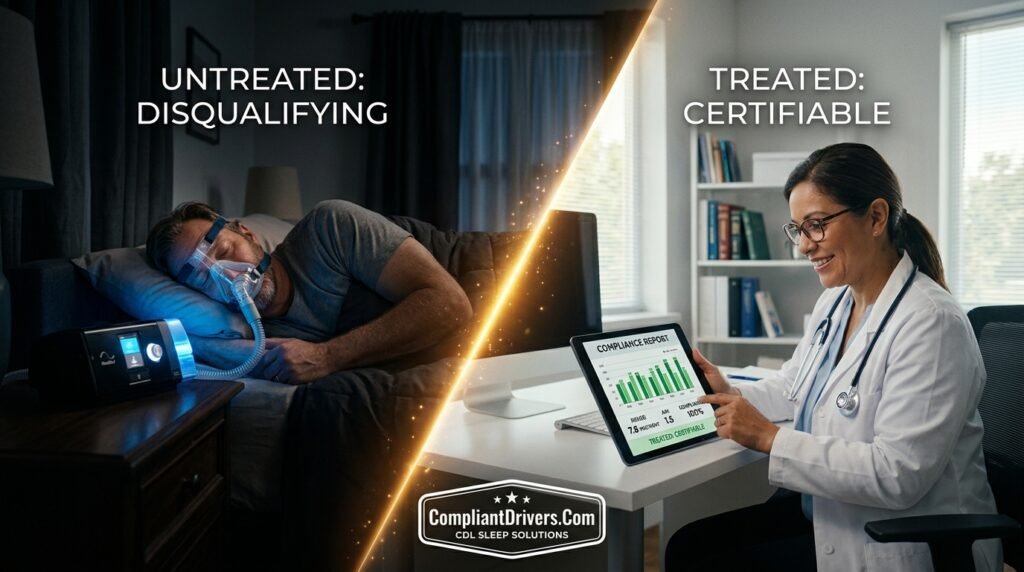
Having sleep apnea does not automatically disqualify you. Having untreated sleep apnea does.
The condition causes breathing interruptions during sleep, which leads to dangerous daytime drowsiness. FMCSA guidance published in the Medical Regulations and Guidance Resource Links document directs examiners to use clinical judgment when evaluating drivers with sleep apnea risk factors.
When Examiners Screen for Sleep Apnea
FMCSA guidance directs examiners to consider sleep apnea evaluation when a driver presents with multiple risk factors, including:
- BMI over 35
- Neck circumference above 17 inches (men) or 15.5 inches (women)
- Diagnosed hypertension
- History of witnessed apnea events or excessive daytime sleepiness
- Prior OSA diagnosis
There’s no single mandatory trigger — each examiner applies clinical judgment. If yours identifies risk factors, they may issue a temporary certificate (typically 60–90 days) and require a sleep evaluation before granting a full-term card.
Sleep Apnea Treatment for CDL Drivers
The most common treatment is CPAP (continuous positive airway pressure) therapy. CPAP machines record usage data automatically. Examiners typically require:
- Minimum 4 hours of CPAP use per night
- Documented compliance on at least 70% of nights
- A follow-up report from the treating sleep specialist confirming symptom resolution
Drivers successfully treating sleep apnea usually receive 1-year medical certificates, renewed annually with updated compliance data.
The sleep study itself — either home-based or in a certified lab — is a medical diagnostic procedure. Unlike the DOT physical, it’s often covered by health insurance. Home sleep tests typically run $150–$500. Lab-based polysomnography costs more but is sometimes required when home test results are inconclusive.
Diabetes and CDL Certification
Non-insulin-treated diabetes is manageable under standard certification. The examiner evaluates control through glucose and HbA1c levels and certifies accordingly.
Insulin-treated diabetes now has a pathway through the FMCSA Exemption Program. Before 2003, insulin-using drivers were categorically disqualified from interstate driving. The exemption program now allows qualified drivers to receive a federal exemption and be certified.
General requirements include:
- Stable diabetes management on insulin for at least 12 months
- No severe hypoglycemic episodes requiring third-party assistance in the previous 12 months
- Documentation from a treating physician or endocrinologist
- Quarterly monitoring records
The exemption application and full requirements are detailed on the FMCSA Medical Exemption Programs page. The process takes time — plan well ahead.
Blood Pressure Management and Your Medical Card
High blood pressure is one of the most common conditions among commercial drivers, and it’s directly controllable with treatment. Here’s what the numbers mean for certification again:
Below 140/90 earns a standard 2-year card. Stage 1 hypertension (140–159/90–99) gets you a 1-year card requiring annual recertification. Stage 2 (160–179/100–109) results in a 3-month temporary card — bring it under control and return. A reading of 180/110 or higher on exam day means no certification until pressure is managed.
If you take blood pressure medication, don’t skip doses before an exam. Your medication is doing its job — it’s working for you, not against your certification.
What to Bring to Your DOT Physical
Don’t arrive empty-handed. Here’s your checklist:
- Full medication list — every prescription and over-the-counter drug, with dosages and frequency
- Corrective lenses — glasses or contacts if you use them
- Hearing aid — if applicable
- Prior DOT medical certificate — for documentation continuity
- Specialist clearance letters — if you have a known cardiac, neurological, or orthopedic condition requiring prior specialist sign-off
- CPAP compliance data — if you’re being recertified with an OSA diagnosis
- Government-issued photo ID
If you have a complex medical history, a brief written summary helps the examiner and reduces the chance anything important gets missed.
How DOT Physical Results Connect to Your CDL Compliance
Your exam data flows into FMCSA’s system within 24 hours. State licensing agencies access that data to update CDL records. You’re also responsible for submitting a copy to your state DMV — check your state’s specific timeline since it varies.
Your employer must maintain a copy in your Driver Qualification File under 49 CFR 391.51. Driving with an expired medical certificate generates CSA points under the Driver Fitness BASIC and can affect your carrier’s FMCSA safety rating.
Set a renewal reminder 60 to 90 days before your expiration date. If your condition requires annual certification, put that appointment in the calendar each year. Finding an examiner, scheduling, and handling follow-up testing takes time — don’t cut it close.
Pros and Cons of Different Exam Provider Types
| Provider | Pros | Cons |
|---|---|---|
| Occupational health chain | High volume, fast, nationwide | Impersonal, may upsell testing |
| Independent examiner | Often cheaper, more flexible hours | Harder to find, variable experience |
| Urgent care center | Convenient, walk-in | May lack CMV-specific experience |
| Truck stop clinic | No separate trip needed | Limited availability by location |
Frequently Asked Questions
Only if your doctor is listed on the FMCSA National Registry of Certified Medical Examiners. Many primary care physicians are not on the registry. Search at nationalregistry.fmcsa.dot.gov before assuming your doctor qualifies.
You receive written documentation identifying the reasons. Depending on the cause, you may be able to address the condition and retest. For example, Stage 2 hypertension earns a 3-month temporary card — get your blood pressure under control and return for re-evaluation.
Up to 24 months for standard certification. Conditions such as controlled hypertension, diabetes management, or sleep apnea treatment typically result in 12-month cards requiring annual renewal.
Yes. FMCSA operates under federal law, and cannabis remains a Schedule I substance federally. State medical or recreational laws have no effect on this standard. A positive drug test prevents certification until return-to-duty requirements through the FMCSA Clearinghouse are complete.
No. Operating a commercial vehicle without a valid medical certificate is a federal violation. Schedule your exam before your current card expires — don’t wait until the last day.
