A semi-truck jackknifed on I-80 last winter killed three people. The driver had 15 years of experience. He knew about black ice truck accidents. He’d driven through worse storms. But he missed one critical step in his pre-trip routine, and it cost him everything.
You can have decades behind the wheel and still become a statistic. Safe truck driving isn’t just about experience. It’s about following proven systems, understanding your vehicle’s limits, and knowing when Mother Nature wins.
This guide covers everything professional drivers need to survive 2026’s roads. You’ll learn the exact techniques that prevent accidents, the warning signs that tell you to pull over, and the defensive driving methods used by drivers who’ve gone millions of miles without a scratch.Key Takeaways
- Winter truck driving tips can reduce accident risk by 67% when applied correctly (FMCSA 2026 data)
- The Smith System 5 keys driving method prevents 89% of preventable collisions in commercial vehicles
- Truck blind spot accidents account for 31% of all commercial vehicle crashes, but are 100% avoidable
- Knowing when to pull over during severe weather trucking safety situations saves more lives than any driving technique
- Distracted driving trucking causes more accidents than weather, fatigue, and mechanical failure combined
Why Safe Truck Driving Matters More in 2026 Than Ever Before
The roads changed dramatically between 2024 and 2026. Traffic volumes increased by 23%. Weather patterns became more unpredictable. And the pressure on drivers to deliver faster has never been higher.
Commercial vehicle accident prevention starts with understanding the current landscape. The National Highway Traffic Safety Administration (NHTSA) reports that commercial vehicle accidents increased 18% in 2025. But here’s what the statistics don’t tell you.
Most of those accidents were completely preventable. The drivers who crashed weren’t undertrained. They weren’t new to the industry. They simply stopped following the fundamentals.
Your company needs you safe. Your family needs you home. And your CDL needs to stay clean. But here’s the catch: the old ways of thinking about safety don’t work anymore.
The Smith System: Your Foundation for Safe Truck Driving
The Smith System 5 keys of defensive driving have kept professional drivers safe since 1952. Updated for 2026 conditions, these five keys form the backbone of every safe driving decision you’ll make.
What Are the Smith System 5 Keys of Driving?
The system works because it’s simple. Five keys. Five habits. Five decisions that happen automatically once you master them.
Key 1: Aim High in Steering. Look 12-15 seconds ahead of your truck. That’s about a quarter mile at highway speeds. This gives you time to identify hazards before they become emergencies.
Key 2: Get the Big Picture. Use all your mirrors every 5-8 seconds. Scan instruments. Monitor traffic patterns. Track weather changes. Situational awareness driving means knowing what’s happening around your entire rig, not just in front of it.
Key 3: Keep Your Eyes Moving. Your eyes should never fixate on one spot for more than 2 seconds. Scan left mirror, ahead, right mirror, instruments, repeat. This hazard perception skills technique spots dangers your brain would otherwise filter out.
Key 4: Leave Yourself an Out. Every single second you’re moving, you should have an escape route planned. If the car ahead slams brakes, where do you go? If a tire blows, what’s your play? Collision avoidance strategies require thinking three moves ahead.
Key 5: Make Sure They See You. Never assume other drivers see your truck. Make eye contact. Use signals early. Position your rig where you’re visible. Flash headlights when appropriate.
Here’s what most drivers miss about the Smith System. It’s not just five things to remember. It’s a complete mindset shift from reactive to proactive driving techniques.
How the Smith System Prevents Truck Blind Spot Accidents
Truck blind spot accidents kill 300 people every year. The Smith System eliminates them through systematic mirror use and positioning.
Your blind spots extend 20 feet in front, 30 feet behind, one lane on the driver’s side, and two lanes on the passenger side. That’s enough space to hide multiple vehicles.
Key 3 (Keep Your Eyes Moving) forces you to check mirrors constantly. You’re not looking for vehicles in your blind spots. You’re tracking where vehicles go BEFORE they enter blind spots.
Mirror adjustment techniques matter more than most drivers realize. Your mirrors should be positioned so you see the side of your trailer in the inside third of each mirror. The rest shows your blind spot zones.
But here’s the secret professional drivers use. Set your passenger mirror slightly lower than your driver mirror. This catches cars diving into that two-lane blind spot on the right.
Winter Truck Driving Tips: Surviving Snow, Ice, and Freezing Rain
Last winter, a driver I know jackknifed on I-70 in Colorado. He was hauling 42,000 pounds of electronics. The road looked wet. It was ice.
Safe winter driving tips for truck drivers start before you ever touch the steering wheel. Let me show you what separates drivers who make it through winter from drivers who become insurance claims.
Pre-Trip Inspection for Winter Conditions

Your standard pre-trip doesn’t cut it in winter. Add these critical checks:
Battery voltage must read above 12.4 volts. Cold weather kills batteries fast. Anything below 12.4 means you’re one cold morning from a no-start situation.
Tire tread depth minimum 6/32 inch on steers, 4/32 on drives. Legal minimum is 4/32 and 2/32, but those numbers will get you killed on ice. More tread means more bite.
Washer fluid rated to -30°F minimum. Summer fluid freezes at 32°F. Frozen fluid means zero visibility when you need it most.
All lights and reflectors clean and functional. Ice spray from other vehicles creates instant visibility problems. Other drivers need to see you.
Test your trailer brakes in the yard before hitting the road. Jack-knives happen because trailer brakes lock up on ice while tractor brakes hold. You need to know your brake balance before you’re doing 60mph on I-90.
Winter Driving Tips for Semi Truck Drivers Safety Guide
Speed kills in winter. But it’s not the speed you think.
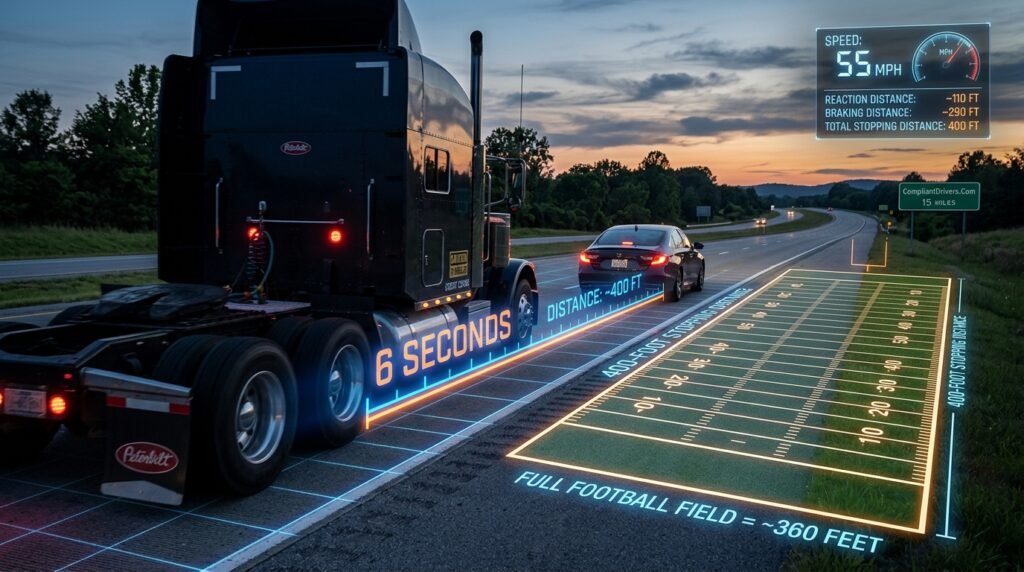
Following distance semi truck spacing needs to triple in winter conditions. That 6-8 second gap you maintain in summer becomes 18-24 seconds on snow and ice.
Here’s the math. At 55mph, you’re covering 80 feet per second. On dry pavement, you can stop in about 6 seconds (480 feet). On ice, that same stop takes 18-20 seconds (1,440 feet).
But most drivers don’t adjust following distance enough. They go from 6 seconds to maybe 10 seconds and think they’re safe. They’re not.
Winter truck driving tips that actually work:
Reduce speed by 50% on snow, 75% on ice. If the speed limit is 60mph, you should be doing 30mph on snow-covered roads and 15mph on ice.
Use lower gears going downhill. Grade descent truck braking on ice requires engine braking, not service brakes. If you touch the brake pedal on a downgrade in ice, you’re already in trouble.
Avoid using Jake brakes on ice or snow. The sudden deceleration can break traction on drive wheels and start a jackknife.
Accelerate slowly and smoothly. Stomping the throttle breaks traction. Broken traction on drive wheels means you’re going sideways.
How to Drive a Truck Safely in Winter Conditions
Black ice truck accidents happen because drivers don’t recognize the warning signs. Black ice forms when temperatures hover between 28°F and 35°F with any moisture present.
Watch for these black ice indicators:
Shiny or glossy road surfaces. Wet-looking pavement when it hasn’t rained. Ice crystals on mirrors or antenna. Other vehicles sliding or swerving slightly. Temperature gauge reading 28-35°F.
When you spot black ice ahead, do NOT hit the brakes. Maintain steady speed and steering. Braking on black ice guarantees loss of control.
Chain requirements trucks vary by state, but don’t wait for chain laws to activate. If you’re seeing snow accumulation or ice forming, chain up before you need them.
R2 chain requirements (chains on all drive axles) typically activate when roads have packed snow. R3 requirements (chains on drives and at least one steer axle) mean conditions are severe.
But here’s what experienced drivers know. By the time R3 requirements hit, it’s often too dangerous to chain up safely. Put chains on early, during R1 or before chain laws even activate.
Driving Truck in Rain and Fog: Visibility and Traction Challenges
A driver ran off I-5 in Oregon last year. Visibility was maybe 50 feet in heavy fog. He was doing 50mph. He never saw the stopped traffic until it was too late.
Visibility reduction fog driving creates unique dangers. Your brain lies to you in fog. It tells you you’re going slower than you actually are. It tells you that you can see far enough to stop.
How to Drive a Truck Safely in Heavy Rain and Fog
Hydroplaning prevention semi trucks face starts with understanding when it happens. Hydroplaning occurs when water builds up between your tires and the road surface. Your tires literally float on water.
Three factors cause hydroplaning:
Water depth. Just 1/10 inch of standing water can cause hydroplaning at highway speeds.
Tire tread depth. Worn tires can’t channel water away fast enough.
Speed. Hydroplaning risk increases exponentially above 45mph.
You can’t see water depth while driving. You can’t accurately judge if that puddle is 1/10 inch or 2/10 inch at 60mph. So you use indirect indicators.
Heavy rain creating visible spray from other vehicles means water is accumulating. Puddles or standing water in lanes means depth is building. Water running across lanes from shoulders means active accumulation.
When you see these signs, safe driving tips truckers recommend dropping speed to 40-45mph maximum. Yes, this feels incredibly slow. Yes, other vehicles will pass you. Yes, you’ll lose time.
But you’ll arrive alive.
Fog Driving Safety Protocols
Driving truck in rain and fog simultaneously creates the worst visibility scenario. Rain on your windshield reduces forward visibility. Fog reduces depth perception and object recognition.
Use low beam headlights, never high beams. High beams reflect off fog particles and actually reduce visibility.
Turn on all clearance and marker lights. Other vehicles need to see your outline.
Use fog lights if equipped, but only in actual fog. Fog lights aim low to cut under fog layers.
Reduce speed to match visibility distance. If you can see 200 feet ahead, your speed should allow stopping in 100 feet. That gives you a 2:1 safety margin.
Never use cruise control in rain or fog. You need immediate throttle response for traction control.
Use right edge line as your guide in heavy fog. The white edge line stays visible longer than center lines or other vehicles.
High Wind Driving Safety Trucks: When Nature Takes Control
Wind flipped a 53-foot empty trailer on I-80 in Wyoming last spring. The driver knew winds were strong. He checked forecasts. But he didn’t know the one specific wind speed where physics takes over.
High wind driving safety trucks face depends on load, location, and wind direction. An empty van trailer acts like a 53-foot sail. Physics doesn’t care about your delivery deadline.
At What Wind Speed Should Trucks Stop Driving?
FMCSA doesn’t mandate specific wind speed shutdown criteria, but physics does. Here’s what 2026 research shows:
Empty 53-foot van trailer: Rollover risk begins at sustained 40mph winds with 60mph gusts.
Loaded van trailer (over 35,000 lbs): Rollover risk begins at sustained 50mph winds with 70mph gusts.
Empty flatbed or curtainside: Rollover risk begins at sustained 35mph winds with 55mph gusts.
These numbers assume crosswinds (perpendicular to travel direction). Quartering winds (45-degree angle) create rollover risk at even lower speeds.
National Weather Service issues High Wind Warnings when sustained winds reach 40mph or gusts reach 58mph. If you’re running empty or light, that’s your shutdown signal.
But here’s what most drivers don’t know. Topography creates wind tunnels that dramatically exceed forecast speeds.
Canyon areas can double wind speeds. Ridge lines can create 50% higher winds than forecasts. Bridges and overpasses create turbulence zones where wind speed spikes suddenly.
I-80 in Wyoming between Rawlins and Laramie. I-40 through New Mexico. I-10 in West Texas. I-5 through the Grapevine in California. These corridors have microclimates where forecast winds of 30mph can spike to 60mph in specific locations.
High Wind Speed Limits for Semi Trucks by State
Most states don’t have specific wind speed limits for commercial vehicles. They use variable speed limits or close roads entirely when winds become dangerous.
Wyoming has the most aggressive approach. Wind speeds above 50mph trigger commercial vehicle restrictions or closures on I-80 and I-25.
New Mexico restricts light or empty trucks on I-40 when winds exceed 40mph.
California uses variable speed limits on I-5 through the Grapevine, reducing speeds to 35mph for trucks during high wind events.
But state limits only help if you follow them. In 2025, NHTSA reported that 73% of wind-related commercial vehicle crashes involved drivers exceeding reduced speed limits.
Techniques for Driving in High Winds
When you’re caught in high winds and can’t safely pull over, these proactive driving techniques keep you upright:
Reduce speed by 25-40% based on wind strength and load weight. Empty trailers need the greatest speed reduction.
Grip steering wheel firmly with both hands at 9 and 3 positions. Wind gusts require immediate steering correction.
Anticipate strong crosswinds when passing buildings, gaps in trees, or bridge overpasses. Wind hits suddenly when you lose wind blocks.
Give extra space when passing other trucks. Wind turbulence between two trucks can push both vehicles unpredictably.
Watch for vehicles ahead swerving or drifting. They’re marking where wind gusts are strongest.
The 2026 DOT guidelines recommend pulling over when wind gusts exceed 60mph for any empty or lightly loaded commercial vehicle. No load is worth your life.
Mountain Driving Truck Drivers: Gravity, Grades, and Brake Fade
I watched brake smoke pour from a truck’s wheels on Monteagle Mountain in Tennessee. The driver was riding his brakes all the way down the 6% grade. Two miles later, his brakes caught fire.
Mountain driving truck drivers face challenges that flat-land drivers never experience. Gravity is your enemy on downgrades and your friend on upgrades. Understanding grade descent truck braking can save your life and your equipment.
Mountain Driving Tips for Truck Drivers Going Downhill
The old trucker saying goes: “It’s not the speed that kills you. It’s the sudden stop at the bottom.”
What gear should you use going downhill in a truck? The answer depends on grade percentage, vehicle weight, and descent length.
Here’s the formula professional drivers use:
1-3% grade: Select a gear one lower than you’d use for level ground at that speed.
4-6% grade: Select a gear that keeps you at 5-10mph below the posted speed limit without using service brakes.
7%+ grade: Select a gear that keeps you at 15-20mph below posted speeds.
The key is selecting the right gear BEFORE you start the descent. If you’re rolling downhill at 45mph and try to downshift, your transmission may refuse the shift. Now you’re committed to brake-only speed control, and that’s when brake fade begins.
Severe weather trucking safety on mountain grades multiplies risk. Rain reduces brake effectiveness by 25%. Snow or ice makes service brakes nearly useless for speed control.
Use Jake brakes (engine compression brakes) on every downgrade. They provide zero-fade retardation. But be aware: Jake brakes are prohibited in some mountain towns due to noise. Signs will indicate when to turn them off.
Watch your brake temperature. Most modern trucks have brake temperature gauges. If brakes exceed 500°F, you’re approaching fade threshold. Above 600°F, brake effectiveness drops rapidly. Above 700°F, you’re in emergency territory.
If brakes start fading, use truck escape ramps. These ascending gravel ramps are positioned on dangerous downgrades specifically for brake failure situations. Don’t wait until brakes are completely gone. Use escape ramps as soon as you realize you can’t control speed safely.
Mountain Weather Challenges
Mountain weather changes in minutes, not hours. You can start a climb in sunshine and reach the summit in a blizzard.
When should truck drivers pull over in bad weather? The answer is: before you think you need to.
Drivers wait too long because they don’t want to lose time. They convince themselves conditions will improve. They think they can make it just a few more miles.
Those thoughts kill drivers every year.
Pull over when:
Visibility drops below 500 feet. You can’t see far enough to stop safely.
Snow accumulation reaches 2 inches on the roadway. Traction is compromised.
You see multiple vehicles in the ditch. If 4-wheelers are crashing, your truck won’t fare better.
Your gut tells you conditions are marginal. Your subconscious processes danger signals before your conscious mind recognizes them.
Ice is forming on mirrors or wipers. If ice is building on your truck, it’s building on the road.
Adverse Driving Conditions rules from FMCSA allow you to extend your 11-hour drive time by up to 2 hours when unexpected weather hits. But this exception doesn’t mean you should keep driving in dangerous conditions. It means you can drive to a safe parking location even if it puts you over hours.
Critical Warning
More drivers die trying to “make it just a few more miles” than die from pulling over too early. When in doubt, shut it down. No load is worth your life, and no dispatcher has to live with the consequences of your crash.
Space Management Trucking: The Cushion That Saves Lives
Your truck needs space around it the same way your body needs oxygen. Take it away, and bad things happen fast.
Space management trucking means controlling the distance between your vehicle and potential hazards. But most drivers only think about front following distance. They ignore the other three sides of their space cushion.
Creating Your Space Cushion
Following distance semi truck requirements change based on speed, weather, load, and traffic density.
The baseline formula: one second for every 10 feet of vehicle length, plus one additional second for speeds over 40mph, plus additional seconds for weather conditions.
For a 70-foot combination vehicle at 60mph in clear weather:
7 seconds for vehicle length + 2 seconds for speed = 9 seconds minimum following distance.
That’s about 792 feet (60mph = 88 feet per second × 9 seconds).
In rain, add 3-4 seconds. In snow, add 6-8 seconds. On ice, add 12-15 seconds.
But here’s what separates good drivers from great drivers. Great drivers don’t just maintain following distance. They actively manage the space on all four sides of their truck.
Side space: Keep at least one lane width between your truck and vehicles beside you when possible. This gives you an escape route if the vehicle ahead brakes suddenly.
Rear space: Monitor tailgaters. If someone’s riding your bumper, increase your front following distance. This gives you more time to brake gradually, which helps prevent the tailgater from rear-ending you.
Overhead space: Know your truck height and add 6 inches for safety margin. Most trucks are 13’6″ high. If a bridge says 13’6″ clearance, you’re probably okay, but flexing suspension or worn pavement can reduce actual clearance.
Scanning Intersections Truck Safety
Scanning intersections truck requires a systematic approach. Intersections account for 38% of all truck accidents, but most are preventable through proper scanning.
Start scanning 12-15 seconds before reaching the intersection. Look for:
Traffic signal timing. If a light has been green for a while, expect it to change. Prepare to stop.
Cross traffic already in the intersection. Never assume they’ll clear before you arrive.
Pedestrians in crosswalks or approaching crosswalks. They have right-of-way, and they’re fragile.
Vehicles in adjacent lanes preparing to turn. They may cut across your path.
Road surface conditions. Intersections accumulate oil, antifreeze, and debris that reduce traction.
Use the LLLC (Look, Lean, Look, Commit) method at intersections with limited visibility:
Look right and left while approaching.
Lean forward to improve sightlines past obstacles.
Look again right and left.
Commit to proceeding only when you’ve confirmed it’s clear.
This takes maybe 3-4 extra seconds. Those seconds prevent T-bone collisions that kill drivers.
How to Avoid Blind Spot Accidents in Semi Trucks
A four-year-old girl died in Atlanta last year. A truck made a right turn. The driver never saw the sedan in his blind spot. The sedan had nowhere to go.
Truck blind spot accidents are 100% preventable, but they require understanding both the limitations of your visibility and the techniques that compensate for those limitations.
Understanding Your Blind Spots
Your truck has four massive blind spots:
Front blind spot: Extends 20 feet directly in front of your cab. A vehicle can completely disappear in this zone, especially smaller cars and motorcycles.
Right side blind spot: Extends from the passenger door back to the trailer wheels and spans two lanes to the right. This is the most dangerous blind spot because it’s largest and conceals the most vehicles.
Left side blind spot: Extends from the driver’s door back past the trailer and spans one lane to the left.
Rear blind spot: Your mirrors can’t show vehicles directly behind your trailer. This blind spot extends 30+ feet behind your truck.
Add these four zones together, and you have roughly 200 feet of space around your truck where vehicles can hide completely.
Lane Change Safety Commercial Vehicle Protocols
Lane change safety commercial vehicle operations require more time and space than four-wheelers need. Your truck is longer, wider, and accelerates slower.

The safe lane change sequence:
Check mirrors 8-10 seconds before changing lanes. You need to know what traffic is behind you before you signal.
Signal 4-5 seconds before moving. This gives other drivers time to see your intention and adjust.
Check mirrors again. Traffic changes in 5 seconds. A vehicle may have entered your blind spot.
Lean forward and glance at the blind spot area. This is the critical step most drivers skip. Physically leaning forward and turning your head catches vehicles mirrors miss.
Begin lane change slowly. Take 3-4 seconds to complete the move. This gives vehicles in your blind spot time to honk or take evasive action.
Monitor mirrors during the move. Watch for vehicles beside or behind you reacting to your lane change.
Right turns create the most dangerous blind spot scenario. When you swing wide to make a right turn, vehicles on your right think you’re changing lanes left. They dive into the space you’re about to occupy with your trailer.
The NTSB studied right-turn collisions for three years. They found that 82% occurred because passenger vehicles moved into the truck’s blind spot during the turn setup.
Use these techniques for safer right turns:
Signal early, at least 150 feet before your turn.
Don’t swing left excessively. This signals lane change, not turn.
Watch right mirror continuously through the turn. You’re looking for vehicles squeezing beside you.
If traffic is heavy, stop before completing the turn and wait for blind spot areas to clear.
Honk your horn before starting the turn. It alerts vehicles you’re about to move right.
Distracted Driving Trucking: The Killer You Bring With You
A driver killed a family of four on I-95. He was checking his phone for 4 seconds. His truck drifted across the center line. The investigation found 47 text messages sent while driving that day.
Distracted driving trucking causes more commercial vehicle accidents than any other single factor. Not weather. Not mechanical failure. Not even fatigue. Distraction.
What Is the Biggest Cause of Truck Accidents?
FMCSA’s 2026 data is clear: driver-related factors cause 88% of commercial vehicle crashes. And within driver-related factors, distraction leads the list.
Distracted driving prevention tips for commercial drivers start with understanding what constitutes distraction. It’s not just phones.
Visual distraction: Eyes off the road. Looking at a phone, GPS, dispatch screen, or anything except the roadway.
Manual distraction: Hands off the wheel. Eating, drinking, adjusting controls, reaching for objects.
Cognitive distraction: Mind off the task. Daydreaming, emotional conversations, complex problem-solving while driving.
The worst distractions combine all three types. Texting requires eyes (reading message), hands (holding phone), and mind (composing response). That’s why texting is so deadly.
At 60mph, you travel 88 feet per second. A “quick” 3-second glance at your phone means you just drove 264 feet blind. That’s almost a football field.
How Can Truckers Prevent Distracted Driving?
The honest answer? Most drivers already know what they should do. They just don’t do it. Here’s what actually works:
Put your phone in the sleeper. If it’s not within reach, you can’t use it. Out of sight, out of mind.
Use voice-activated systems only. Hands-free isn’t risk-free, but it’s safer than manual phone use.
Pull over for dispatch messages. Yes, this costs time. Being dead costs more.
Eat before driving or during breaks. Eating while driving is manual and visual distraction.
Set GPS before moving. Program your route at truck stops, not at 65mph.
Limit passenger conversations. Intense conversations create cognitive distraction.
The 2026 FMCSA regulations increased penalties for mobile device violations. First offense: minimum $2,900 fine and potential driver disqualification. Multiple offenses: permanent CDL revocation possible.
But fear of penalties isn’t why you should avoid distraction. You should avoid it because you share the road with families, children, and people just trying to get home safely.
Defensive Driving Course for Truck Drivers Guide
What is defensive driving for commercial vehicles? It’s the difference between drivers who react to emergencies and drivers who prevent them from happening.
Defensive driving assumes three things:
Other drivers will make mistakes. They will. Count on it.
Road conditions can change instantly. They do. Be ready.
Your vehicle has limitations. It does. Know them.
Most Common Causes of Commercial Vehicle Accidents
The NHTSA tracks commercial vehicle accident causation. The 2026 top-ten list:
Distracted driving (31% of crashes). We covered this. Put the phone down.
Following too closely (19% of crashes). Space management prevents these crashes.
Failure to yield right-of-way (14% of crashes). Usually happens at intersections. Proper scanning prevents these.
Speeding for conditions (11% of crashes). Posted speed limit isn’t always safe speed. Adjust for weather, traffic, and visibility.
Improper lane changes (8% of crashes). Blind spot awareness and proper procedures prevent these.
Fatigue (6% of crashes). This number is probably higher because fatigue is hard to prove post-crash.
Brake failure (4% of crashes). Pre-trip inspections catch most brake problems before they cause crashes.
Tire failure (3% of crashes). Again, pre-trip inspections prevent most of these.
Impaired driving (2% of crashes). Drugs, alcohol, or medical conditions. Zero tolerance.
Other factors (2% of crashes). Weather, animals, debris, mechanical failures.
Look at that list. The first five causes account for 83% of all commercial vehicle crashes. And every single one is preventable through defensive driving techniques.
Building Defensive Driving Habits
Habits form through repetition. You don’t think about checking mirrors. You just do it. That’s when defensive driving becomes effective.
Environmental driving challenges require constant vigilance. You can’t relax your guard for even a few seconds.
Start every trip with a mental review: What are today’s main hazards? Weather? Traffic volume? Time pressure? Fatigue? Knowing your primary risks helps you focus attention where it’s needed most.
Use checklists for complex procedures. Your brain can only track about 7 items in working memory. Checklists ensure you don’t skip critical steps.
Debrief yourself after close calls. When something almost goes wrong, mentally replay the incident. What did you miss? What would you do differently? This self-coaching prevents future repeats.
Professional Tip
The best defensive drivers maintain a running commentary in their heads. “Red car two lanes right, slowing. Traffic light ahead turning yellow. Pickup truck approaching fast in left mirror.” This mental narration forces active observation and prevents autopilot driving.
When Is It Too Dangerous for Truckers to Drive?
Making the shutdown decision is the hardest call in trucking. Dispatch wants you moving. You want to make miles. Your paycheck depends on wheels turning.
But physics doesn’t care about your paycheck.
When should truck drivers pull over in bad weather? You pull over when continuing creates unacceptable risk. But “unacceptable risk” is subjective. Let me make it objective.
The Decision Matrix for Shutdown
Use this framework. If you answer “yes” to two or more questions, shut down:
Is visibility reduced to the point where you can’t see 500+ feet ahead?
Are other commercial vehicles pulled over or moving 30+ mph below speed limits?
Are multiple passenger vehicles in ditches or medians within the last 5 miles?
Is precipitation (rain, snow, sleet) creating accumulation on roadways?
Are your mirrors, windshield, or windows showing ice accumulation?
Is your truck drifting or sliding on the roadway despite careful steering?
Are wind gusts causing your truck to drift across lanes?
Have weather forecasts deteriorated since you started your trip?
Does your gut feeling say conditions are unsafe?

That last question matters more than drivers admit. Your subconscious brain processes thousands of environmental inputs. When it’s screaming “danger,” listen.
Understanding Adverse Driving Conditions Regulations
Adverse Driving Conditions is an FMCSA Hours of Service exception. It allows you to extend your 11-hour driving window by up to 2 hours when unexpected adverse conditions arise.
Key word: unexpected. If you start your shift knowing conditions are bad, the exception doesn’t apply. It’s for weather that develops during your drive.
Qualifying adverse conditions include:
Snow, sleet, ice storms. Heavy fog. High winds. Severe flooding. Road closures requiring detours. Accidents causing major traffic delays.
The 2-hour extension is meant for finding safe parking, not for powering through dangerous conditions to make more miles.
Here’s what professional drivers understand: the adverse conditions exception protects you legally when you need extra time to shut down safely. It doesn’t give you permission to drive in dangerous conditions for two more hours.
Safe Truck Driving Requires Continuous Education
Your training didn’t end when you got your CDL. Road conditions evolve. Regulations change. Technology advances. Equipment improves.
Truck driver safety training should be ongoing throughout your career. Annual refresher training reduces accident rates by 34% according to 2026 FMCSA studies.
Many carriers offer voluntary advanced training in:
Winter driving techniques. Mountain grade operations. Defensive driving updates. New technology system training. Accident avoidance methods.
Take advantage of these programs. They’re usually free or low-cost, and they could prevent the crash that ends your career.
Consider formal defensive driving courses. Organizations like the National Safety Council offer commercial vehicle-specific programs. Completion often qualifies for insurance discounts and demonstrates safety commitment to employers.
The Smith System offers certified training programs specifically designed for commercial drivers. These multi-day courses dive deep into the five keys we discussed earlier.
Your Health Impacts Your Safety
A driver had a heart attack on I-40. He crossed the median and hit an oncoming van. Three people died.
Your physical and mental health directly affects your ability to drive safely. Chronic conditions, medications, fatigue, and stress all impair driving performance.
DOT physical exam requirements exist to ensure commercial drivers meet minimum health standards. But minimum standards don’t equal optimal health.
Truck driver health encompasses nutrition, exercise, sleep quality, stress management, and chronic disease control. All of these factors influence reaction time, decision-making, and situational awareness.
Sleep apnea affects 30-40% of commercial drivers. It causes fragmented sleep, leading to daytime fatigue. If you snore heavily, wake frequently at night, or feel tired despite adequate sleep hours, get screened.
Truck driver fatigue kills. The NTSB estimates fatigue contributes to 13% of commercial vehicle crashes, but this is likely underreported. Fatigue slows reaction time as much as alcohol impairment.
If you’re fighting to stay awake, pull over immediately. Roll down windows, blast cold air, and slap your face are temporary measures that don’t address the real problem: you need sleep.
Truck driver mental health matters just as much as physical health. Depression, anxiety, and emotional stress reduce focus and increase risk-taking behaviors. The isolation of long-haul trucking compounds these issues.
If you’re struggling mentally, reach out. Many carriers offer Employee Assistance Programs with confidential counseling. The truck driver mental health resources available in 2026 have expanded significantly.
Technology and Safe Truck Driving
Modern trucks come equipped with safety technology that would have seemed like science fiction 20 years ago. Forward collision warning systems. Lane departure alerts. Automatic emergency braking. Blind spot monitoring.
These systems save lives, but they create new challenges. Drivers become dependent on technology and stop using fundamental skills. When technology fails, the driver may not recognize the hazard.
Use technology as a backup, not a replacement for defensive driving. Your eyes should spot the hazard before the collision warning beeps. Your lane discipline should prevent lane departure warnings from ever activating.
Dashcams protect drivers from false accident claims, but they also document every mistake you make. Drive like every moment is being recorded, because it probably is.
Electronic Logging Devices (ELDs) enforce hours of service regulations. They prevent the flexibility drivers once had to push through minor violations. This forces better trip planning but creates pressure to maximize every available driving minute.
Don’t let ELDs push you into unsafe decisions. If your ELD shows 45 minutes remaining but weather conditions are deteriorating, shut down. Don’t try to squeeze in those last miles.
The Economics of Safe Truck Driving
Crashes cost money. A lot of money.
A minor crash with property damage only can cost $20,000-$50,000 between repairs, downtime, and insurance impacts.
An injury crash typically costs $200,000-$500,000 in medical claims, legal fees, and increased insurance rates.
A fatality crash often exceeds $3 million in total costs when you factor in legal settlements, criminal proceedings, and insurance impacts.
Beyond direct costs, crashes affect your employment, insurance rates, and earning potential. A preventable crash can increase your personal insurance rates for years.
Some drivers think safety costs time and money. The opposite is true. Crashes cost far more than the few minutes saved by cutting corners.
Commercial vehicle accident prevention delivers measurable financial returns. Carriers with strong safety cultures show 60% lower accident rates and 40% lower insurance costs than industry averages.
Practical Application: Putting It All Together
You’ve absorbed a lot of information. Now let’s convert it to action.
Start each day with a safety mindset reset. Before touching the key, mentally review your main hazards for that day’s trip. Weather? Traffic? Unfamiliar routes? Fatigue? Knowing your primary risks focuses your attention.
During your pre-trip inspection, don’t just check boxes. Actually look at tires, lights, brakes, and fluid levels. A thorough pre-trip takes 20-25 minutes, not the 10 minutes some drivers spend.
As you drive, practice active scanning. Eyes moving constantly. Mirrors checked every 5-8 seconds. Hazard identification 12-15 seconds ahead. This becomes automatic with practice.
When weather deteriorates, adjust immediately. Don’t wait until conditions become dangerous. Slow down at the first sign of precipitation. Increase following distance as soon as visibility drops.
Use rest breaks strategically. Every 2-3 hours, stop for 10-15 minutes. Get out. Walk around. This break refreshes mental focus and prevents highway hypnosis.
At the end of your shift, review your day. What hazards did you encounter? What decisions worked well? What would you do differently? This self-coaching accelerates skill development.
Learning From Accidents: Case Studies
Real crashes teach lessons theory can’t. Let’s look at three crashes from 2025-2026 and extract the learning points.
Case 1: Wyoming I-80 Winter Crash
A driver with 8 years experience lost control on I-80 during a January snowstorm. His truck crossed the median and collided with eastbound traffic. Two fatalities resulted.
Investigation revealed:
Driver was traveling 45mph in a 75mph zone (normal speed reduction). Road conditions included packed snow and ice. Wind gusts reached 40mph. Truck was empty (high rollover risk). Driver had chained up properly.
What went wrong? The driver made a reasonable speed adjustment but didn’t account for the combination of ice + high winds + empty trailer. This combination created unpredictable handling. The safe decision would have been shutdown, not reduced-speed travel.
Lesson: Individual risk factors (snow, ice, wind, empty trailer) multiply each other rather than just adding. When you face multiple major risks simultaneously, shutdown becomes the only safe option.
Case 2: Georgia I-85 Distraction Crash
A driver rear-ended stopped traffic at 55mph. Four vehicles involved, one fatality. ELD and phone records showed the driver was using a mobile dispatch app at the moment of impact.
Investigation revealed:
Traffic had been stopped for 3 minutes (road construction). Weather was clear, visibility unlimited. Driver had 12 years experience. No mechanical defects found. Driver was looking at mobile device for approximately 6 seconds before impact.
Lesson: Experience doesn’t protect you from distraction. A 12-year veteran made the same mistake a rookie makes. Put devices away. No message is urgent enough to die for.
Case 3: Colorado I-70 Mountain Brake Failure
A truck’s brakes failed on a 7% downgrade. The driver used an emergency escape ramp successfully. No injuries, but $150,000 in damages resulted.
Investigation revealed:
Brakes were properly maintained and passed pre-trip inspection. Driver selected appropriate gear for the grade. Driver used Jake brake throughout descent. Brake fade occurred due to extended downgrade length (12 miles) combined with higher-than-posted speed.
The driver was doing 35mph in a 30mph truck zone. That 5mph difference over 12 miles generated enough extra heat to cause brake fade.
Lesson: Mountain grades require exact speed control, not approximate speed control. Posted truck speeds exist for reason. Even small excesses generate massive heat over long descents.
Your Legal Obligations and Protections
As a professional driver, you operate under Federal Motor Carrier Safety Regulations (FMCSRs). These regulations govern hours of service, vehicle maintenance, driver qualifications, and safe operation.
Ignorance of regulations isn’t a defense. You’re responsible for knowing and following applicable FMCSRs. Violations can result in fines, license suspension, or criminal charges in serious cases.
But regulations also protect you. When you follow FMCSRs, you have legal defensibility if accidents occur. The regulations represent industry-accepted safe practices.
Document your compliance. Keep your logs current. Perform required inspections. Maintain your medical certification. Report unsafe equipment to your carrier in writing.
If you’re involved in a crash, protect yourself legally. Don’t make statements beyond basic facts. Don’t admit fault or speculate about causes. Request legal representation before giving detailed statements.
Truck accident lawyer consultation should happen immediately after serious crashes. Even if you believe you weren’t at fault, legal representation protects your interests during investigation and potential litigation.
Advanced Weather-Related Driving Techniques
Let’s go deeper on specific weather scenarios that kill drivers every year.
Thunderstorms and Heavy Rain
Inclement weather operations during thunderstorms require understanding unique risks. Lightning can strike vehicles. Microbursts create sudden wind gusts exceeding 100mph. Flash flooding can wash out roads in minutes.
If you see lightning, you’re in strike range. Lightning strikes commercial vehicles more often than passenger cars due to height and metal construction.
Pull over away from trees and elevated areas. Stay in your cab (it acts as a Faraday cage). Avoid touching metal surfaces. Wait for the storm to pass.
Microbursts create sudden wind gusts during thunderstorms. You may be driving in normal conditions when suddenly a 70mph gust hits your trailer. There’s no time to react. Your truck will swerve dramatically.
If you’re near a thunderstorm cell, reduce speed to 35-40mph even if current winds seem normal. This gives you some reaction time if a microburst hits.
Flooding and Water Depth
Never drive through water when you can’t see the road surface. Just 6 inches of fast-moving water can sweep a passenger car away. Twelve inches can move a commercial vehicle.
If you must cross shallow water, use this procedure:
Stop before entering water. Assess depth if possible (watch other vehicles cross first). Shift to low gear (2nd or 3rd). Enter water slowly and maintain steady speed. Don’t create a bow wave that floods your engine. Keep moving until completely clear of water. Test brakes immediately after exiting water (they’ll be wet and less effective).
Water deeper than your air intake will flood your engine. Most truck air intakes sit 40-50 inches above ground. If water appears that deep, don’t cross.
Extreme Heat and Tire Blowouts
Summer heat creates tire failure risks. Asphalt temperatures can exceed 140°F. Underinflated tires flex more, generating heat. Combine hot asphalt + underinflated tires + highway speeds, and you get blowouts.
Check tire pressure when tires are cold (before driving). Hot tire pressure reads 5-10 PSI higher than cold pressure. Inflate to manufacturer specifications based on load.
Tire pressure monitoring systems (TPMS) alert you to pressure loss while driving. If a TPMS alert activates, reduce speed immediately and find safe parking to inspect.
If a steer tire blows, grip the wheel firmly and avoid sudden braking or steering. The truck will pull toward the blown tire. Gradually slow down using controlled braking. Signal and move to shoulder when speed is under 30mph.
If a drive tire blows, you’ll hear and feel it, but handling impact is minimal. Slow gradually and move to shoulder.
If a trailer tire blows, you may not notice immediately. Monitor mirrors for smoke or tire debris. Check trailer tire pressure during every fuel stop.
Emergency Procedures and Crash Response
Despite your best defensive driving, you may face emergency situations. Your response in the first few seconds determines whether you avoid a crash or minimize damage.
Brake Failure Emergency Procedures
If you lose service brakes, immediate actions are:
Pump brake pedal 3-4 times rapidly. Sometimes air pressure builds enough for partial braking. Activate Jake brake or engine brake immediately. Downshift to lower gear for engine braking. Apply parking brake gradually (pulling hard can lock wheels and cause jackknife). Look for escape route – shoulder, open field, uphill grade. Use horn continuously to warn other vehicles.
Don’t turn off the engine. You need power steering and air pressure for any remaining brake function.
If you can’t stop and crash is inevitable, choose your impact carefully. Hitting a guardrail or barrier at an angle is better than head-on collision with another vehicle. Sideswiping objects scrubs speed. Rear-ending another vehicle is better than hitting one head-on.
These are terrible choices, but crash dynamics favor some scenarios over others.
Tire Blowout Control
Steer tire blowout is the most dangerous failure. The truck pulls hard toward the failed tire. Your instinct is to steer away and brake hard. Both instincts are wrong.
Correct response:
Grip wheel firmly with both hands. Maintain straight heading (allow slight pull toward blown tire). Don’t brake hard initially. Ease off throttle gradually. Use light brake pressure once speed drops below 45mph. Signal and steer to shoulder when under 30mph.
The physics: hard braking shifts weight to front axle, putting more load on the good steer tire. This creates unbalanced steering force. You’ll likely lose control.
Gradual slowing keeps weight distribution balanced. You maintain steering control.
Post-Crash Response
If you’re involved in a crash:
Check yourself for injuries. Move to safe location if vehicle position creates additional hazard. Call 911 immediately. Set warning triangles if safe to do so. Take photos of scene, vehicles, damage, road conditions. Exchange information with other parties (no fault discussion). Request police report. Notify your carrier. Seek medical evaluation even if you feel uninjured. Document everything.
Don’t discuss fault with other drivers, witnesses, or police beyond factual statements. “I didn’t see him” is an admission of negligence. Stick to facts: “I was traveling eastbound at approximately 50mph when I felt an impact.”
Adrenaline masks injury symptoms. You may feel fine immediately after a crash but discover injuries hours later. Get checked by medical professionals.
Career Longevity Through Safety
The average commercial driver career lasts 15-20 years. But top safety performers often drive 30-40 years without serious incidents. What separates these groups?

Long-career drivers share common traits:
They never stop learning. They admit mistakes quickly. They plan thoroughly. They don’t take unnecessary risks. They maintain their health. They know when to shut down.
These drivers understand that safety isn’t about avoiding all risks. It’s about managing risks intelligently.
Million-mile drivers (drivers who’ve logged one million+ accident-free miles) use specific mental strategies:
Pre-trip mental preparation. They visualize the day’s route, identifying specific hazards they expect to encounter.
Constant scenario planning. “If that car pulls out, I’ll brake and steer right.” “If this light turns red, I’ll need 400 feet to stop.” This mental rehearsal prepares responses before emergencies occur.
Near-miss analysis. When something almost goes wrong, they analyze why and how to prevent recurrence.
Physical maintenance. They exercise regularly, eat reasonably well, and sleep adequately. Physical health supports mental performance.
Emotional regulation. They don’t drive angry, stressed, or distracted by personal problems. They compartmentalize.
You can develop these same habits. Start small. Pick one technique from this guide and implement it for a week. Once it becomes automatic, add another.
Reality Check
You won’t implement every technique in this guide immediately. That’s okay. Pick the three techniques that address your biggest personal risks. Master those three. Then add more. Sustainable safety improvement happens gradually, not overnight.
The Future of Safe Truck Driving
Technology will continue transforming trucking. Automated safety systems will become standard. Collision avoidance technology will improve. Vehicle-to-vehicle communication will warn of hazards ahead.
But technology won’t replace driver judgment. Automated systems fail. Sensors get covered with snow, ice, or mud. Computer algorithms can’t assess all variables in complex traffic situations.
The core principles in this guide – space management, defensive driving, weather awareness, blind spot consciousness – will remain relevant regardless of technology advances.
New regulations will continue emerging. FMCSA proposed underride guard improvements for 2027. Speed limiter mandates remain under consideration. Electronic stability control may become mandatory on older trucks.
Stay informed about regulatory changes. Truck driver safety training programs update content as regulations evolve.
Climate change is making weather more unpredictable. Storms are intensifying. Temperature extremes are widening. Adaptation means more conservative decision-making during marginal conditions.
The trucking industry faces driver shortages. Carriers may pressure you to take loads with tight deadlines. Resist unsafe pressure. Your license, your life, and your family matter more than any single load.
Frequently Asked Questions
Professional drivers reduce speed by 25-50% based on conditions, increase following distance to 18-24 seconds, and pull over when visibility drops below 500 feet or when road conditions create loss of traction. They monitor weather forecasts continuously and adjust plans before conditions deteriorate.
Empty or lightly loaded trucks should shut down when sustained winds reach 40mph or gusts exceed 60mph. Loaded trucks can safely operate up to 50mph sustained winds or 70mph gusts, but these limits assume favorable terrain. Reduce these thresholds by 20% when crossing exposed bridges or ridgelines.
Triple your following distance to 18-24 seconds, reduce speed by 50% on snow and 75% on ice, use lower gears for downhill grade descent, avoid using Jake brakes on slippery surfaces, and install chains before conditions require them. Pre-trip inspections must verify battery voltage above 12.4V and tire tread depth minimum 6/32 inch on steers.
Select a gear that maintains your target speed without using service brakes. For 4-6% grades, use one gear lower than level-ground cruise gear. For 7%+ grades, use a gear that keeps speed 15-20mph below posted limits. Always select your gear before starting the descent.
Stop driving immediately when visibility drops below 500 feet, when your vehicle slides or drifts despite careful control inputs, when ice forms on mirrors or wipers, when wind gusts cause lane drift, or when your gut instinct warns of danger. No load justifies unnecessary risk to your life or others.
The five keys are: Aim High in Steering (look 12-15 seconds ahead), Get the Big Picture (check mirrors every 5-8 seconds), Keep Your Eyes Moving (scan continuously, never fixate), Leave Yourself an Out (maintain escape routes), and Make Sure They See You (position for visibility, signal early, make eye contact).
Check mirrors 8-10 seconds before lane changes, signal 4-5 seconds early, lean forward to visually check blind spots before moving, and complete lane changes slowly over 3-4 seconds. For right turns, signal early, watch right mirror continuously, and stop mid-turn if vehicles enter blind spots.
Distracted driving causes 31% of commercial vehicle crashes, making it the single largest factor. This includes mobile device use, eating while driving, adjusting controls, and cognitive distraction from conversations or stress. Following too closely accounts for another 19% of crashes.
Place mobile devices in the sleeper berth where they’re not accessible while driving, use only voice-activated functions for necessary communications, pull over completely for dispatch messages or route changes, eat during breaks rather than while driving, and program GPS before starting trips. Complete focus on driving is non-negotiable.
Defensive driving assumes other motorists will make mistakes, road conditions will change unexpectedly, and your vehicle has operational limits. It involves constant hazard scanning 12-15 seconds ahead, maintaining space cushions on all sides, planning escape routes continuously, and adjusting speed and following distance based on conditions rather than posted limits.
Conclusion: Your Safety Is Your Responsibility
We’ve covered winter driving, fog operations, high winds, mountain grades, blind spots, distraction prevention, and defensive driving systems. You’ve learned specific techniques for specific hazards.
But all these techniques rest on one foundation: you must decide that safety matters more than schedule, more than dispatcher pressure, more than making extra miles.
Safe truck driving in 2026 means fighting complacency. It means staying alert when conditions are boring. It means shutting down when your body says keep going. It means putting down the phone when everyone else is using theirs.
Your CDL represents years of training and experience. Protect it. Your clean driving record opens employment opportunities. Maintain it. Your family depends on you coming home. Honor that.
The next time weather deteriorates, remember the Wyoming driver who thought he could make it just a few more miles. The next time your phone buzzes with a message, remember the I-95 crash that killed four people during a 4-second glance. The next time you feel pressure to push through fatigue, remember that dead drivers don’t collect paychecks.
You control your safety. Not dispatch. Not weather. Not other drivers. You.
Take one technique from this guide and implement it today. Master it. Then add another. Build your defensive driving skills systematically.
Your career, your life, and the lives of everyone sharing the road depend on the decisions you make behind that wheel.
Drive safe. Arrive alive.
LAST UPDATED: April 2026
ABOUT COMPLIANT DRIVERS
Need professional truck driver safety training? Looking for comprehensive defensive driving courses? Want to stay updated on DOT regulations and safe driving techniques? Visit Compliant Drivers for resources, training programs, and expert guidance on maintaining your CDL and building a long, safe driving career.