



Safe truck driving is a combination of skills, habits, and decision-making that experienced drivers develop over time. No single technique prevents all accidents, but consistent application of proven defensive driving principles significantly reduces your risk — and the risk you create for everyone else on the road.
This guide covers the practical side of safe truck driving: the Smith System, managing blind spots, adverse weather decisions, distracted driving regulations, and when pulling over is the right call. All of it based on what actually causes commercial truck crashes, not fabricated statistics.
The Reality of Commercial Truck Crashes
Before talking about prevention, it helps to understand what actually causes crashes. The FMCSA Large Truck and Bus Crash Facts report — the most comprehensive federal source on commercial vehicle crash data — consistently identifies recurring factors:
- Driver fatigue and drowsiness on long hauls
- Speeding and following too closely
- Driver distraction from mobile devices and in-cab systems
- Brake issues including worn, overheated, or improperly adjusted brakes
- Tire failures and mechanical defects
- Failure to adjust speed for weather and road conditions
According to FMCSA’s MCMIS data, there were approximately 167,425 reported semi-truck crashes in 2024, including fatal, injury, and property-damage-only incidents. NHTSA’s preliminary data for the first half of 2025 showed an 8.2% decline in overall roadway fatalities compared to the same period in 2024 — a positive trend, though the total numbers remain significant.
What this data tells you practically: most crashes are not random events. They involve identifiable behaviors and conditions. That means most of them are preventable with the right habits and decisions.
The Smith System: Five Keys to Defensive Driving
The Smith System has been used in professional driver training since 1952. It’s not complex theory — it’s five observable habits that shift your driving from reactive to proactive. Every major fleet safety program incorporates these principles in some form.
Key 1: Aim High in Steering
Look at least 12–15 seconds ahead of your truck at highway speeds — roughly a quarter mile. At city speeds, that’s about one block ahead.
Fixating on the vehicle directly in front of you gives you almost no reaction time. Looking further ahead means you see hazards developing before they become emergencies — a car slowing unexpectedly, a lane closure ahead, a light turning red while you still have time to ease off the throttle.
Key 2: Get the Big Picture
No single mirror covers everything around a tractor-trailer. Actively scanning all your mirrors — left side, right side, and the large blind spots specific to your rig — every 5–8 seconds is a discipline, not just advice.
Get the full picture of traffic around you, not just what’s in front. Where are the cars? Who’s moving faster? Is that vehicle in your right blind spot about to pass or holding position? Situational awareness is built through active scanning, not passive glancing.
Key 3: Keep Your Eyes Moving
Fixed gaze creates a tunnel vision effect where your brain filters out movement in the periphery. Eyes should move — mirror to windshield to mirror to instrument cluster, cycling continuously. No single spot should hold your focus for more than two seconds.
This isn’t about paranoia. It’s about keeping your visual processing active so you see things earlier.
Key 4: Leave Yourself an Out
At any moment while moving, you should have an escape route planned. What do you do if the car ahead stops suddenly? If a tire blows on your steer axle? If a vehicle merges into your lane?
Space management is the practical tool here. Maintaining adequate following distance and avoiding situations where you’re boxed in on multiple sides gives you options when something unexpected happens. Running tight gaps eliminates those options.
Key 5: Make Sure They See You
Don’t assume other drivers see your truck. Use your turn signals well in advance — not as you’re already moving over. Make eye contact with drivers at intersections before proceeding. Use your lights in conditions that reduce visibility. Position your truck where it’s visible.

Large trucks are much harder to ignore than a sedan, but that doesn’t mean other drivers are paying attention. Driving as if you’re invisible — while doing everything you can to be seen — is the right mindset.
Managing Truck Blind Spots
A standard tractor-trailer has four blind spot zones that are larger than most passenger vehicle drivers realize:
Front blind spot — roughly 20 feet directly in front of the cab. A vehicle that close is invisible to the driver.
Rear blind spot — approximately 30 feet directly behind the trailer. Following vehicles that close are invisible in mirrors.
Right side blind spot — from the cab back to about the mid-point of the trailer, extending one to two lanes wide. This is the most dangerous zone because drivers on the right have limited visibility of your trailer.
Left side blind spot — smaller than the right but present from the B-pillar back to roughly the trailer mid-point.
The practical rules:
- Position your mirrors to maximize coverage of the sides, not just what’s directly beside the cab
- Before any lane change, check mirrors, signal, pause, check again, then move
- On right turns, watch for cyclists and pedestrians who may be in the right blind spot as you swing wide
- Never assume someone isn’t there — look for confirmation they’re not
The CDL Pre-Trip Inspection guide covers mirror adjustment during pre-trip checks — proper adjustment is the foundation for blind spot management.
Safe Following Distance for Large Trucks
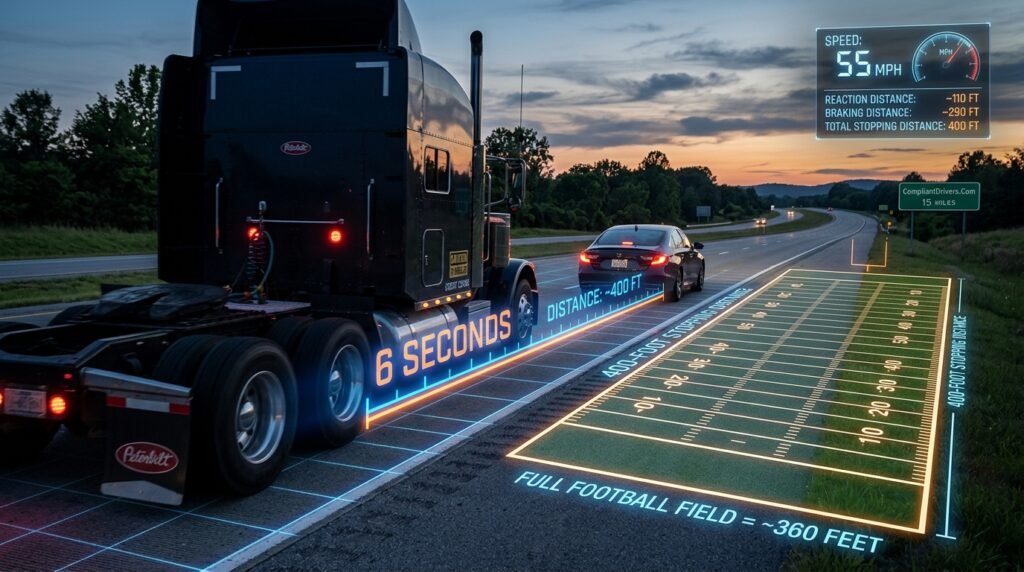
Stopping distance for a fully loaded semi at highway speeds is significantly greater than for a passenger vehicle. At 55 mph on dry pavement, a loaded tractor-trailer needs roughly 400 feet to stop — about the length of a football field. On wet roads, that extends considerably.
A general rule: one second of following distance for every 10 feet of vehicle length, plus one additional second. For a standard 53-foot trailer at highway speeds, that’s at least 6 seconds.
In practice:
- Pick a fixed object ahead (a sign, a bridge)
- When the vehicle in front passes it, count seconds until you pass the same point
- If you reach the object before counting to 6, you’re following too close
Heavy traffic makes maintaining this distance difficult. Other drivers will fill the gap. That’s frustrating but not an argument for closing the gap — it’s an argument for anticipating it and easing back further.
Adverse Weather: When to Pull Over
Weather-related crashes are preventable in a way that other crash types sometimes aren’t — the vehicle can stop. The decision not to is what creates the crash.
Rain and Wet Roads
Wet roads increase stopping distances and reduce tire contact with the pavement. At the start of rain, oil that’s been accumulating on dry pavement mixes with water to create especially slick conditions — often worse than sustained rain.
In rain, increase following distance, reduce speed below posted limits when conditions warrant, and test your brakes gently at lower speeds to feel how the vehicle is responding.
Black Ice
Black ice forms when temperatures are at or near freezing and moisture is present. It’s nearly transparent and looks like wet pavement. Bridges and overpasses freeze before road surfaces because air circulates under them — treat every bridge deck as a potential black ice hazard when temps are near freezing.
If you hit black ice, avoid sudden steering inputs or braking. Hold your line, ease off the throttle, and let the vehicle stabilize. Hard steering or braking on ice typically makes the situation worse.
Wind and Empty Trailers
High winds are disproportionately dangerous with empty or lightly loaded trailers. An empty trailer has a large surface area and minimal weight to hold it down. Crosswinds that a loaded truck handles without difficulty can move an empty trailer significantly.
Know the wind speed thresholds your carrier or your own experience suggests are unsafe for your equipment. Some fleets have specific policies on operating in high wind conditions.
When to Pull Over
There’s no formula that tells you exactly when to stop. The decision involves your speed, road conditions, visibility, your truck’s weight, and what you’d do if something went wrong ahead. But some situations generally call for pulling over:
- Visibility drops below a quarter mile in fog, snow, or rain
- You cannot maintain safe speed without sliding or losing control
- Wind is moving your trailer unpredictably
- Ice is forming on your windshield faster than your defrost can clear it
- You’re fighting fatigue and conditions are worsening
Pulling over costs time. Not pulling over when you should costs more. Pre-plan rest areas and truck stops in your route so you know where you can stop if needed — don’t wait until the decision is urgent.
Distracted Driving: Federal Prohibitions
FMCSA prohibits hand-held mobile phone use and text messaging while operating a commercial motor vehicle under 49 CFR 392.82. The specific violations and penalties:
Texting — manually entering text, sending, or reading a text message while driving. Penalty: up to $2,750 for the driver, up to $11,000 for the carrier.
Hand-held mobile phone use — holding or reaching for a phone to make or receive a call. Penalty: same as above.
Two or more violations within three years results in a 60-day CDL disqualification. Three or more violations results in a 120-day disqualification. These violations also generate CSA points in the Unsafe Driving BASIC.
Using a hands-free device is not prohibited by federal regulations — but hands-free still means looking at the device, reaching for it, or manipulating it in ways that take your attention off driving. The permitted use is a voice-activated, single-button operation that doesn’t require holding or reaching.
Dispatcher contact creates real-world pressure to use phones while driving. The correct procedure is simple: if a call or message can’t wait, pull over safely first. A two-minute delay is not a compliance problem. A distracted driving citation is.

Backing Safety
A disproportionate share of commercial vehicle property damage claims come from backing incidents. The vehicle’s blind spots are maximized when reversing, the trailer swings in unpredictable directions for less experienced drivers, and there are often pedestrians and fixed objects in areas where trucks back.
GOAL — Get Out And Look. Before backing into any spot, physically get out of the truck and walk the path. See what’s behind you that mirrors won’t show. This takes 60 seconds and prevents damage that takes hours to document.
Spotters. In tight spaces or when backing near people, use a spotter. Establish clear signals before backing — hand signals or radio. If you lose contact with your spotter, stop immediately.
Backing camera systems are increasingly standard equipment, but they have limitations — camera angles don’t cover everything, and distance perception on screens is imprecise. Use them as supplements to mirrors and spotting, not as replacements.
The general rule: if you’re not certain what’s behind you, don’t back until you are.
Pre-Trip Inspection and Safe Driving
Safe driving starts before you move. A thorough pre-trip inspection is not just a regulatory requirement under 49 CFR 392.7 — it’s how you know your truck is actually ready to handle whatever conditions you’ll face.
Brake adjustment, tire pressure and condition, lighting, and coupling systems should all be verified before every trip. Defects in these systems are responsible for a significant portion of vehicle out-of-service orders during DOT roadside inspections.
Find a defect during pre-trip? Document it on your DVIR and get it corrected before departure. Operating a vehicle with known defects shifts liability significantly — and creates real risk that’s entirely avoidable.
Fatigue Management
Fatigue is one of the most studied crash factors in commercial trucking. Hours of Service regulations exist specifically to address it — but regulations set minimums, not optimal rest.
Practical fatigue management beyond HOS compliance:
- Get quality sleep, not just enough hours in the sleeper berth
- Recognize early fatigue signs: yawning, lane drift, difficulty focusing, micro-sleep episodes
- Caffeine delays fatigue but doesn’t eliminate it — a 15–20 minute nap before caffeine takes effect is more restorative
- If you’re fatigued, pull over. It’s legal. Driving fatigued is not.
The question to ask yourself: if something goes wrong in the next 60 seconds, am I alert enough to respond correctly? If the honest answer is no, that’s your signal.

Frequently Asked Questions
The Smith System is a defensive driving methodology developed in 1952 and widely adopted in commercial fleet safety training. Major carriers and fleet safety programs incorporate its five principles — aim high, get the big picture, keep eyes moving, leave an out, and make sure they see you — as the foundation of driver coaching programs.
At highway speeds, a minimum of 6 seconds for a standard tractor-trailer combination. That’s one second per 10 feet of vehicle length, plus one additional second. On wet roads or in poor visibility, increase that distance. In construction zones and heavy traffic, maintain as much space as conditions allow.
Federal regulations prohibit hand-held mobile phone use but permit hands-free devices that can be operated without holding or reaching for them. A Bluetooth headset that activates with a single button press without reaching for the phone meets this standard. Reaching for a headset, adjusting it, or holding it to your ear while driving does not.
When you cannot maintain safe control of the vehicle, when visibility prevents you from seeing hazards in time to respond, or when conditions have deteriorated to the point where you’d have no margin for error if something went wrong ahead. Erring toward pulling over in these situations is always the right call.
Properly adjust all mirrors before each trip, actively scan mirrors every 5–8 seconds, never assume a lane is clear — look for confirmation, signal well before changing lanes, and apply the GOAL procedure before backing.