



The CDL written test — formally called the General Knowledge test — is the first exam in the CDL process. You must pass it to get your Commercial Learner’s Permit, which you need before any behind-the-wheel training or skills test can happen. Skipping serious preparation is the most common reason applicants fail and have to wait through mandatory retesting periods.
This guide covers the CDL written test for 2026: what the General Knowledge test covers, how it’s scored, which additional tests apply for different CDL classes and endorsements, and how to study effectively.
The Structure of the CDL Knowledge Tests
The CDL written tests are administered at your state DMV. There is no single national CDL written test — each state administers its own, but all states base their tests on the FMCSA Commercial Driver’s License Manual, which is standardized federally.
General Knowledge test — required for all CDL applicants. Covers vehicle inspection, basic vehicle control, shifting and backing, coupling and uncoupling, pre-trip inspection, and federal regulations governing commercial driving.
Test format: 50 questions in most states. You must answer at least 40 correctly — 80% — to pass. Some states use slightly different question counts; confirm your state’s requirements.
Endorsement knowledge tests — required for endorsements you’re applying for at the time of your CLP. Tests include:
| Test | Questions (Typical) | Passing Score |
|---|---|---|
| General Knowledge | 50 | 40 correct (80%) |
| Air Brakes | 25 | 20 correct (80%) |
| Combination Vehicles | 20 | 16 correct (80%) |
| Hazmat (H) | 30 | 24 correct (80%) |
| Tank Vehicles (N) | 20 | 16 correct (80%) |
| Double/Triple Trailers (T) | 20 | 16 correct (80%) |
| Passenger (P) | 20 | 16 correct (80%) |
| School Bus (S) | 20 | 16 correct (80%) |
Question counts and passing scores vary by state. The table above reflects common requirements — verify your state’s specific thresholds before testing.
What the General Knowledge Test Covers
The General Knowledge test covers seven topic areas. Each area will have questions in the exam — you can’t skip-study any section.
1. Driving Safely
Road rules, speed management, space management, night driving, adverse weather conditions, mountain driving, and distracted driving prohibitions. The federal prohibition on texting and handheld phone use while driving a CMV (49 CFR 392.82) appears here.
2. Transporting Cargo Safely
Loading and unloading basics, cargo weight distribution, securing cargo, inspecting cargo, and recognizing when cargo shifts. The general cargo securement principles from 49 CFR Part 393 are tested here.
3. Air Brakes (if taking the Air Brakes test)
How the air brake system works, component functions, inspection procedures, brake adjustment, and proper braking technique. Separate from General Knowledge but tested in the same session if you’re applying for removal of the air brakes restriction.
4. Combination Vehicles (Class A applicants)
Coupling and uncoupling procedures, inspecting a combination vehicle, managing rearward amplification, converter dollies, and operating doubles and triples.
5. Hazardous Materials (if taking H endorsement test)
Hazard classes, placard requirements, shipping papers, emergency procedures, loading/unloading rules, and federal requirements for hazmat drivers.
6. Pre-Trip Inspection
The purpose and process of pre-trip inspections, what to check in each vehicle area, how to identify defects, and the DVIR requirement. This overlaps with the skills test but appears in the written test as knowledge questions.
7. Basic Vehicle Control
Shifting gears, backing, turning, and space management concepts. These are knowledge questions about technique, not demonstrations.

The Definitive Study Source: Your State CDL Manual
Every state publishes a CDL manual that covers all tested content. This manual is the basis for every question on your written test — not a summary of it, not a paraphrase of it. The actual test questions are drawn from this manual’s content.
Download your state’s CDL manual from your state DMV website. Read it in full. This is the only source that guarantees you’re studying what’s actually being tested in your state.
Why generic study apps sometimes fail: Many CDL study apps use questions from other states’ manuals or generic content. Your state may test different wording, different specific values, or different topics. Starting with your state’s official manual — then supplementing with practice questions — is the right approach.
How to Study Effectively
Read the Manual, Don’t Just Scan It
The manual is denser than a casual read suggests. Read each section completely. When you encounter a specific value — a distance, a time, a percentage — mark it. These specific numbers are what written test questions target.
Examples of specific values commonly tested:
- Minimum following distance calculations
- Low pressure warning activation threshold (60 psi)
- Governor cut-in and cut-out pressure ranges
- Required distance for emergency warning devices
- Blood alcohol limits for CDL holders
Take Practice Tests After Reading
Most state DMV websites offer practice tests. Several free apps and websites provide CDL practice questions. Use these after completing the manual — they reinforce what you’ve learned and identify gaps. Don’t use practice tests as your primary study method before reading the manual; scenario-based questions that require understanding over memorization will trip you up.
Focus on Concepts You Don’t Already Know
Experienced drivers who already know pre-trip inspection and cargo securement in practice sometimes underestimate the written test because the practical knowledge is familiar. The test includes regulatory specifics — exact BAC thresholds, specific CFR references, numerical values — that practical experience doesn’t always cover.
Don’t assume your driving knowledge translates to written test knowledge without reviewing the regulatory specifics.
Know the Federal Regulations, Not Just Procedures
The General Knowledge test includes questions about what federal regulations require — not just how to drive safely. Questions about HOS rules, drug and alcohol prohibitions, and CDL disqualification rules appear regularly. Understanding the regulatory framework, not just the operational procedures, improves your score.

What Happens on Test Day
Bring your government-issued photo ID. Most states require valid ID matching your DMV records to take the test.
Check in at the DMV licensing or testing counter. Some states have dedicated testing areas; others process CDL knowledge tests at standard DMV windows.
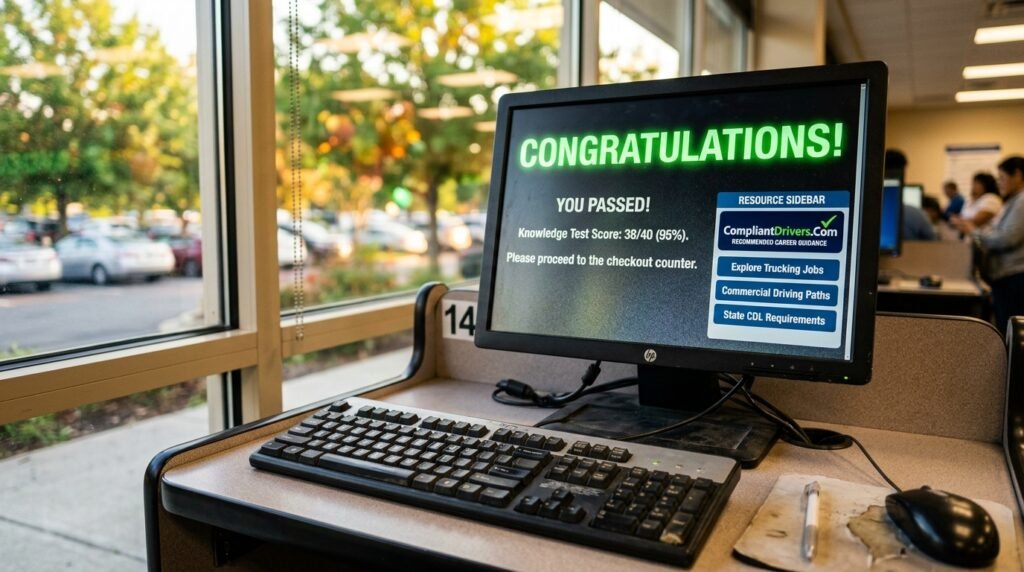
Tests are computer-administered at most DMVs. You’ll sit at a terminal and answer questions on screen. The system typically flags questions you skipped and lets you review before submitting.
You receive your results immediately. The computer scores the test and shows your result. If you pass, you receive paperwork to complete the CLP application. If you fail, you receive information on when you can retest.
Waiting Periods and Retesting Rules
If you fail a knowledge section, most states impose a waiting period before you can retest. Common waiting periods:
- Most states: 1–2 business days minimum
- Some states: Up to 7 days
- Maximum attempts: Some states limit total attempts within a testing cycle before requiring a restart
Check your state DMV’s specific retesting rules before your first attempt. Knowing the rules upfront prevents surprises if you need to retake.
Test fees apply each time — typically $5–$30 per section depending on the state. Failing and retesting has both time and cost implications, which is the practical reason thorough preparation upfront is worth it.
The Commercial Learner’s Permit (CLP)
After passing your required knowledge tests, your state DMV issues a Commercial Learner’s Permit. The CLP:
- Authorizes you to practice driving a CMV on public roads when accompanied by a CDL holder with the same class and endorsements as your CLP
- Must be held for a minimum of 14 days before taking the CDL skills test (federal requirement under 49 CFR 383.25)
- Is valid for 180 days in most states — if it expires before you pass the skills test, you must retest
Your ELDT behind-the-wheel training (if required) happens during the CLP holding period. Our How to Get a CDL guide covers the full process from CLP to licensed CDL.
Frequently Asked Questions
Most states use 50 questions with a passing score of 40 correct (80%). A small number of states use slightly different question counts. Check your state DMV’s CDL information page before testing to confirm.
Yes. Many applicants take the General Knowledge test and endorsement tests (air brakes, combination vehicles, etc.) in the same DMV visit. Some states process all tests consecutively; others have you pay separately for each. Confirm your state’s process.
Various estimates of CDL test failure rates circulate online. We haven’t found a verified federal source for a specific national failure rate. What is clear from state DMV data: failure rates are high enough that DMVs impose waiting periods between retests, and inadequate preparation is the most consistent reason applicants fail. Study the full manual before testing.
No. ELDT (Entry-Level Driver Training) is required before taking the CDL skills test — not the knowledge tests. You can take knowledge tests and receive your CLP without completing ELDT first. ELDT behind-the-wheel training happens during the CLP holding period.
CDL transfers between states are handled at your new state’s DMV. You generally don’t need to retake knowledge tests if your CDL is current and you’re moving the same class license. The new state typically issues a new CDL in exchange for the out-of-state license after verifying your record. Check your new state’s specific transfer process.
